
“Arrogance, ignorance, and incompetence. Not a pretty cocktail of personality traits in the best of situations”
Graydon Carter – US Journalist
70 years ago this month, the colonies of French Indochina were lost when the Communist Viet Minh guerilla army defeated French forces in Vietnam in the Battle of Điện Biên Phủ.
Background
Following the Japanese surrender in World War II, the Viet Minh, a Vietnamese Communist guerilla army declared independence from France. France did not recognise the new government, and the first Indochina War began when the French navy bombarded the port city of Haiphong in northern Vietnam in November 1946, killing thousands of Vietnamese civilians. The war continued for another seven years and by 1953 it was at a stalemate. It had not been going well for the French. The war was unpopular, costly, and the French political environment was unstable. During the seven years of war, there were 16 changes of government in France and 13 changes of prime minister. Clearly, domestic political instability helped undermine the war effort.
Setting
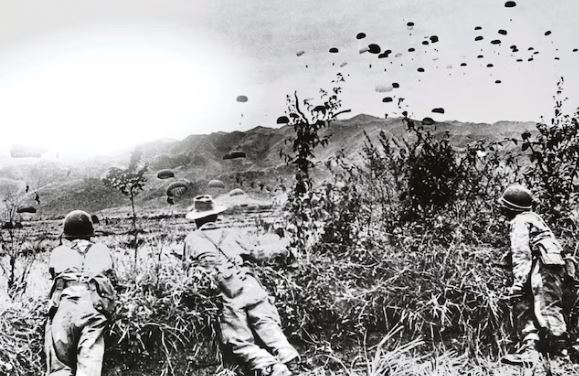
A French needed a solution to break the stalemate, so negotiations could be conducted. The French plan was to create a military situation which would bring the Viet Minh to the negotiating table. In late 1953, 2,000 French paratroopers were dropped deep in Viet Minh held territory in north-western Vietnam at a town called Điện Biên Phủ to establish a heavily fortified base.
The aim was to cut the Viet Minh supply lines from Laos and provide a base from which to attack them in the countryside. The French strategy was to draw out the Vietnamese and destroy them with superior firepower. They believed they held all the military advantages – the military equipment, the planes, trained soldiers, and the artillery. This strategy was called the hérisson (‘hedgehog’) concept. It was based on the success of the 1952 Battle of Nà Sản, where a fortified French camp supplied only by air repeatedly beat back the Viet Minh who suffered heavy losses. By repeating this strategy at Điện Biên Phủ on a much larger scale, using superior artillery and air support, the French believed they could defeat the Viet Minh in set piece battle. But the Viet Minh were fighting a guerilla war.
Outcome
In March 1954, the battle of Điện Biên Phủ began with a massive artillery bombardment by the Viet Minh. They were strategically positioned in caves and dugouts in the hills above the base. This lasted until May when 16,000 troops French were soundly defeated.
With over 50,000 Viet Minh troops surrounding the base, roads to supply the French garrison were cut which necessitated being supplied by air. The French believed that the Viet Minh had no anti-aircraft capacity and limited artillery. This proved to be incorrect, and the planes were forced to fly higher and higher, which resulted in supplies often falling into the Viet Minh’s hands.
The Viet Minh leader, General Giáp had learnt from the losses at Nà Sản. He spent months planning the transporting and stockpiling ammunition, and placing heavy artillery and anti-aircraft guns in tunnels in the hills around the French base. Furthermore, thousands of local peasants who supported the Viet Minh, including many women, provided labour, built roads, cleared jungle, transported food by foot and on bicycles and hauled equipment. Over 300,000 people were involved in the Viet Minh logistical effort.
With tenacious fighting on the ground resulting in horrendous causalities, the Viet Minh dug trenches and gradually encroached on the French base, finally cutting the runway. This forced the French to deliver supplies and reinforcements by parachute. As key positions were overrun, the perimeter contracted. While at times, the French repulsed Viet Minh assaults, airpower and superior military equipment did not win the day. The siege ended with a humiliating defeat for the French with 2,293 killed. The Viet Minh suffered horrendous casualties with over 8,000 Viet Minh fighters killed and an estimated 15,000 wounded.
Are there management lessons from the Battle of Điện Biên Phủ for managers today?
Here are three to consider:
1. Do your homework and understand your competitors – know your enemy
The French underestimated their enemy. The French did not know the number of Viet Minh troops or how many artillery pieces they possessed and, furthermore the French believed that the Viet Minh had no anti-aircraft capability. Not only did they misjudge their enemy, but the French also discounted the huge material support received from the Communist Bloc, in the form of left-over stockpiles of Soviet-made and captured American heavy artillery and anti-aircraft artillery from the Korean War. By comparison, Giáp knew the strength and weaknesses of the French from his spies in the camp, and from the hills overlooking the French base. Unlike the battle of Nà Sản, the Viet Minh controlled the high ground, a major strategic oversight by the French. Clearly, the French did not do their homework, were arrogant and had no Plan B.
2. Technological superiority does not guarantee success
The French strategy was to defeat the Viet Minh in a set piece battle using their superior military technologies and resources – artillery, aircraft, trucks and tanks. Artillery and tanks had been dismantled and delivered by air and then reassembled on the ground. This strategy did not suit a guerrilla war, where having the support of the general population is critical. The Viet Minh’s supply chain did not rely on the use of modern technologies such as aircraft, but instead thousands of peasants carried food, ammunition and the dismantled artillery pieces into hidden and protected positions in the hills above the base. It was a triumph of logistical planning.
Technology can make you vulnerable. The Viet Minh’s artillery closed the airstrip halfway through the siege, necessitating parachute resupply. The efficient anti-aircraft artillery forced the planes higher, and a high proportion of the supplies fell into the Viet Minh’s hands, including ironically the French Commander’s new general’s stars dropped with a bottle of champagne.
My experience in niche logistics business was when our biggest competitor decided to invest millions of dollars in state-of-the-art equipment and take out a long-term lease on an expensive warehouse. Their major customer, a major retailer was slow to use their services, and they eventually ran out of money and were bankrupted.
3. Be prepared to change your plan when conditions or the situation changes
Giáp’s initial strategy was based on the Communist Chinese “Fast Strike, Fast Victory” model. The aim was to attack the French garrison command centre with overwhelming force to a secure victory. However, the Viet Minh found out that the French knew about this plan, and their technological superiority combined with well dug in troops would have made this strategy fail. Instead, Giáp changed to a siege strategy. This helped ensure success. By mid-1953, the First Indochina War was in its seventh year and for either side there was no obvious prospect of victory. The French had tried a variety of tactics to defeat the Viet Minh, which failed. Exhausted and devoid of ideas, they had no long-term vision or overall strategy, which was in stark contrast to the Viet Minh. They simply defended their positions and reacted to attacks when they occurred.
A road transport client of mine, experienced a drop in revenue by 75%. However, he became far more profitable by changing their strategy, ditching difficult and unprofitable customers.
Do you think there are any other lessons for managers?
#thenetworkofconsultingprofessionals
 5-Dimensionz