
“People who work together will win, whether it be against complex football defences, or the problems of modern society”
Vince Lombardi – legendry NFL Football Coach
What is the Wallace Line?
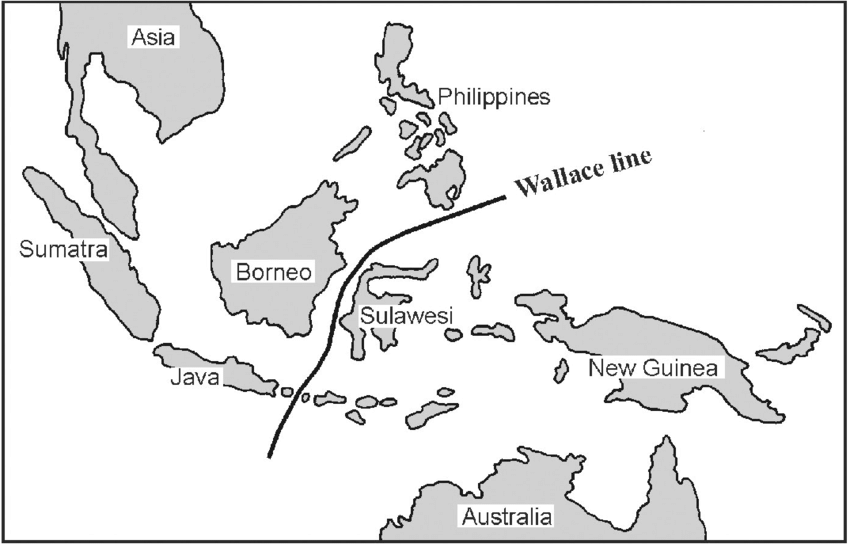
The Wallace Line is a bio-geographic boundary that runs roughly north-south through Indonesia, separating Borneo and Sulawesi and on through the Lombok Strait between Bali and Lombok. The distance between these two islands is less than 30 kms. I suspect many of my readers have holidayed on Bali and not known they had crossed the Wallace Line on their flight!
On each side of the Wallace Line there are differences in flora and fauna. On the Asian side there are placental mammals such as apes, cats, elephants, monkeys and rhinoceroses but no marsupials. On the eastern or Australian side, there are eucalyptus trees and species of marsupials (animals with pouches) and some monotremes (echidna and platypus). Several years ago on a visit to Timor Leste I was amazed to see eucalyptus trees. When I was trekking in PNG many years ago I saw cockatoos and of course, tree kangaroos.
In summary, the Wallace Line separates Australian and Southeast Asian fauna. It roughly follows the merging of four major tectonic plates in an area of high seismic and volcanic activity.
How was the Wallace Line identified and named?
The Wallace was named after Alfred Russel Wallace (1823-1913), a British naturalist and explorer. He is best known for his work on biogeography and evolutionary theory. Wallace’s longest period of fieldwork was in the islands of Southeast Asia. Here he observed flora and fauna, and collected specimens of insects, butterflies, birds, reptiles, and mammals and noted the differences in fauna.
He published his findings in 1869 in The Malay Archipelago and dedicated the book to Charles Darwin. Wallace was a contemporary of Charles Darwin and his contributions to the theory of evolution were invaluable to Darwin. In fact, Wallace and Darwin collaborated on the idea of natural selection and presented their findings jointly to the Linnean Society in London. Darwin however published his book “On the Origin of Species” in 1859, 10 years before Wallace published his book.
Consequently, Wallace became a footnote in history.
Wallace did not name the line himself. A naturalist, Thomas Huxley in an 1868 presented to the Zoological Society of London a paper on the distribution of gallinaceous birds in the Indonesian archipelago. In it, Huxley coined the faunal distribution as “Wallace’s Line”.
What has the Wallace Line got to do with management?
Well, nothing directly.
However, using symbolism to tell a story or emphasise a point is a valuable management tool.
But perhaps in a metaphorical sense, the concept of the Wallace Line offers a lens through which to view the inner workings of organisations. Just as the line demarcates two worlds of species and ecosystems, invisible boundaries often exist within organisations—dividing departments and branches. These lines may not be drawn on any map, but their effects are just as profound, shaping communication, collaboration, and the movement of ideas.
The Wallace Line reminds us that even in spaces where geography or policy would suggest seamless integration and barriers can exist. Unfortunately, there are politics in any organisation.
Is there a Wallace Line in your organisation?
Does Marketing talk to Production?
Do Sales adhere to the credit policies administered by Finance?
Does the Perth branch communicate with their fellow colleagues in Sydney?
Does Admin talk to people in line or production areas?
As managers recognising and navigating these boundaries is essential in seeking to foster true organisational cohesion. That’s the lesson from the Wallace Line.
@thenetworkofconsultingprofessionals



 5-Dimensionz