
“There’s a difference between criminals and crooks. Crooks steal. Criminals blow some guy’s brains out. I’m a crook”
Ronnie Briggs – Great Train Robber
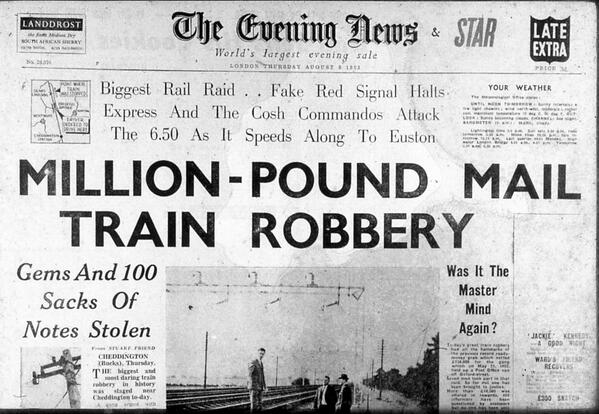
Sixty years ago, this month on 8th August 1963 the Glasgow–London Royal Mail Train was held up by 15 men, wearing helmets, ski masks, and gloves. The train was carrying mostly used bank notes to be destroyed. This was known as the Great Train Robbery. The ringleader, Bruce Reynolds was a known burglar and armed robber. Just over £2,600,000 (£50m today) was stolen in an audacious and apparently well-planned heist aided by inside information. It only took 15 minutes. No firearms were used, although the train’s driver was seriously injured when bashed with a metal bar.
Before the Great Train Robbery, Reynolds had organised a gang and conducted a successful £62,000 airport robbery. Flush with this success, Reynolds began searching for ‘the next big one’. Upon identifying the opportunity, Reynolds realised that he needed help from the London underworld as his original gang could not do the job alone.
The train was stopped when the robbers turned off a green track signal with batteries and turned on a red signal. Approximately 120 mail bags were taken from the train to a farm hideaway, where it was divided up. During the robbery, one of the gang told the postal staff on the train not to move for 30 minutes. This information suggested to the police that the hideout was within a 30-mile radius.
On hearing on the radio that the police were narrowing the search, the robbers hurriedly left the farm the day after the robbery. Only five days after the robbery a local farm worker had noted suspicious vehicles at a neighbouring farm and advised the police. When two police came to the farm, they found the Landrovers and truck used in the robbery, plus bedding, food, post office bags, banknote wrappers and a monopoly board. Part of the plan was to burn down the farmhouse. However, the robbers in their haste left fingerprints on a tomato sauce bottle and the monopoly board. Apparently, the robbers had played monopoly with real money from the heist!
The robbery had attracted far more police attention than anticipated by the robbers. It also captured the imagination of the public and the media. A reward of £250,000 was offered. A breakthrough came when an informant gave the police a list of names. Some of the names were matched to the fingerprints from the farm. With this and other evidence, by Christmas 12 robbers had been caught, convicted and sentenced up to 30 years jail.
Only three of the robbers remained at large. Reynolds and two others went abroad to Mexico and lived the highlife. By 1968 Reynolds had spent most of his ill-gotten gains. He planned another large robbery and returned to England where he was arrested. Ronnie Biggs escaped from prison in 1965, fled first to Paris, then after undergoing plastic surgery travelled to Australia, and finally to Brazil in 1970. He remained at large as there was no extradition treaty between Brazil and the UK. In 2001 after suffering several strokes, he returned voluntarily to the England and was rearrested.
Are there any lessons here for managers in this ‘crime of the century’ (apart from the obvious lessons of crime not paying and it’s not a good idea to play Monopoly with real money)?
The robbery was well planned and executed with military precision. But by Christmas in 1963, 12 of the robbers had been arrested. Hardly a sign of success!
Here are three lessons I think we can take away from the Great Train Robbery:
- 1. Have a vision.
Reynolds as the leader was the brains behind the daring heist. Following the ‘success’ of the airport robbery, Reynolds wanted a bigger challenge. In the dialogue from a movie of the robbery, Reynolds was quoted as saying:
“You’ve got to dream big. What are we here for if we don’t make our mark? It was never just about the cash. It’s the buzz. Building the team, finding the job, planning the job, carrying it out. It’s the camaraderie. Trusting other men with everything you know. With your life.”
Although this is a fictional quote it is probably is an accurate depiction of what occurred. Reynolds had clear vision – in other words a vision statement! The power of vision is very powerful. An ingredient of a successful business is to have a very clear vision.
- 2. Plan thoroughly.
With a clear vision, Reynolds meticulously prepared and planned the robbery. He realised that the scope was beyond his immediate circle’s skills and quickly expanded the size and skills of the gang. He was faced with needing specific skills to ensure success. This included how to fake the train signals to stop the train and how to drive the train once it was held up. Sound planning allowed the initial success of the robbery – in 15 minutes.
- 3. You cannot plan for all eventualities and you should have a plan B.
Despite the meticulous planning, the robbers did not plan for all eventualities. In reality, in business it is also not possible to plan for all eventualities. However, you should always have a Plan B. A contingency plan if ‘things go wrong’. When calm leadership was required, the gang panicked when they heard that the police were searching within a 30-mile radius of the robbery. They left the farm and didn’t adequately cover their tracks. In other words, despite the planning there was poor execution which resulted in the robbers being caught.
In concluding, there is nothing like a good story to demonstrate a point and the Great Train Robbery certainly does this!
What do you think?
Note: I am not condoning the robbery that left the train driver seriously injured. Just using a well-known story as an example for managers. The robbery was a success, but many things went wrong after that. The amount stolen was so much more than expected that it sparked a major investigation plus “crime of the century” publicity. The police response was swift and successful. An example of sound management and leadership.
#thenetworkofconsultingprofessionals
 5-Dimensionz
‘Twas a good story thanks David.
Hope there were some lessons as well aprat from ‘don’t play monopoly with real money’!