“History gives answers only to those who know how to ask questions.”
Hajo Holborn, German-American historian (1902-1969)
I grew up on a farm in the state of NSW, Australia. I learnt many management lessons from farm life. The bordering property, a hilly, rough and timbered farm was established in the early 1900s was called “Spion Kop”. Certainly, an unusual name for an Australian farm.
Where did this name originate from?
In NSW alone there are five mountains called Spion Kop. The clue was in the time of establishment of the property – in the early 1900s. This was the time of the Boer War. Australia did not become an independent nation until 1901, and in a fervour of British Empire patriotism landmarks and people’s names reflected back to this war. I had a Great Uncle, born in 1900 called Baden Powell Hull, named after the ‘hero’ of the siege of Mafeking in the Boer War in modern day South Africa, Baden Powell the founder of the Scout’s movement.
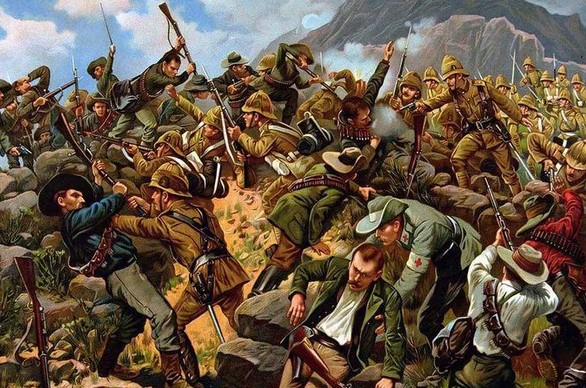
Anyway, I digress. The Battle of Spion Kop was a pivotal encounter in the Boer War which took place in January, 1900. In English, the term ‘spion kop’ an Afrikaans word means ‘spy hill’ or ‘lookout hill’. This clash, near Ladysmith in South Africa, pitted the British Empire forces against the Boers of the Transvaal and Orange Free State.
Who were the commanders and what were their Tactics?
- British Commanders: General Sir Redvers Buller led the overall British campaign, with Lieutenant-General Sir Charles Warren in direct command at Spion Kop. The British aimed to relieve the Siege of Ladysmith and decided to take the strategically important hill of Spion Kop. Their plan involved a direct assault and securing the hilltop. However, due to inadequate reconnaissance, the British were unaware of the hill’s true geography and the strength of Boer positions.
- Boer Commanders: The Boer forces were commanded by Generals Louis Botha and Piet Joubert. Botha was particularly instrumental during the battle. The Boers, adept in guerrilla warfare, utilised the terrain to their advantage. They engaged in defensive tactics, occupying higher ground surrounding Spion Kop and targeting the British with sniper and artillery fire.
What was the outcome of the Battle of Spion Kop?
- Territorial Outcome: The British initially captured Spion Kop but failed to secure it due to intense Boer resistance and misjudgements about the terrain. This led to their eventual retreat and a strategic victory for the Boers.
- Casualties: The British suffered heavy losses, with approximately 1,000 casualties (dead, wounded, or captured). The Boers had significantly fewer casualties, estimated at around 300.
Lessons for Modern Managers
- Importance of Information and Planning: The British lack of reconnaissance reflects the critical need for managers to gather comprehensive information and plan accordingly. Understanding the market, competition, and operational environment is key to strategic success.
I remember an instant very clearly where I thought I could prepare a capital expenditure application (Capex) sitting in my office in Melbourne for an environmental washing plant for a concrete plant located in regional Victoria. Being somewhat clever I gathered ‘letters of protest’ from neighbours, including an employee whose letter that had been embellished. Upon touring the area with my General Manager several weeks later, he brought out the Capex and standing near where I had said the washing plant was to be located started asking questions. The document explained where the wastewater was running – and it was up hill, which was obviously not immediately obvious from my office in Melbourne! The General Manager ‘smelt a rat’. He wanted to talk to the owner of the house most affected by the wastewater (who happened to be the employee). I remained calm and said he was probably not home – well he wasn’t home he was only 20 metres away in batch office. Keeping calm and a straight face I survived the interrogation and with the General Manager saying “I’m not convinced”. Lesson learnt.
- Leadership and Decision Making: The British command structure at Spion Kop, was confusing and orders were conflicting. This underscores the necessity of clear, decisive leadership in management. Leaders must communicate effectively, make informed decisions, and ensure team alignment.
In a previous blog, I described a major transport company where managers were recognised for their ability to react to a ‘crisis’, a ‘can do culture’ rather than being recognised for their management skills. The business was full of ‘operations heroes’. In such an environment, being a manager there was a challenge. I took a different approach, and empowered my supervisors, implemented a culture of discipline, and provided clear reporting responsibilities with significant success. The branch became the most profitable in the company, with the lowest damage and labour turnover.
- Adaptability and Innovation: The Boers’ successful use of guerrilla tactics against a conventionally superior force highlights the value of adaptability and innovation in management. Modern managers should be flexible, ready to adjust strategies in response to changing circumstances, and open to innovative approaches.
In our former logistics business, we had issues with waiting time at a retailer’s distribution centre. Cartons were hand unloaded, which is very time consuming rather than being unloaded on pallets using a forklift. I came up with the idea of using standard shipping containers on a trailer and leaving them on site. This allowed the retailer to unload in their own time. This was successful and proved beneficial to the retailer by being more flexible with scheduling unloading times and eliminated waiting time for us. This led to us purchasing two cheap second-hand van trailers which were used instead, improving our margins and giving us flexibility in loading for delivery.
Do you think there are other lessons we can learn as managers from the Battle of Spion Kop?
While the Boers’ tactics of utilising terrain and guerrilla warfare led to their victory, the British suffered due to poor reconnaissance, ineffective leadership, and rigid tactics. These historical insights remain profoundly relevant for today’s managers, emphasising the importance of thorough preparation, effective communication, and the ability to adapt to evolving situations.
Do you think there are other lessons?
Post Note: over 20 years ago I visited the actual Spion Kop in South Africa. A bare hill overlooking the surrounding countryside, it was very eerie with lines of British graves marked by white stones and a cross.
@thenetworkofconsultingprofessionals
 5-Dimensionz