The Great Emu War

“The incompetent leading the unwilling to do the unnecessary.”
Evan Wright – American author

Military failure is everywhere. As managers and leaders, we can learn from classic instances of so-called military incompetence. There are many examples from the disastrous Allied landing at Gallipoli in World War I, to operation Barbarossa, the failed Nazi invasion of Soviet Union in World War II and to the 1954 Battle of Dien Bien Phu in French Indochina which resulted in catastrophic defeat for the French.

However, few examples could be more humorous, without loss of human life and just as instructive for managers on ‘what not to do’ as the Great Emu War of 1932.

What are the characteristics of an emu?

They are an enormous bird second in size to the African ostrich. They cannot fly and have an average height of over 2 metres, very strong legs, can run up to 50 kph, and naturally flock in large numbers.

Background to ‘the conflict’

Following the end of World War I, the Australian government ‘rewarded’ returning soldiers with farm land. In Western Australia the veterans or ‘soldier settlers’ were allocated farmland which was very marginal for the growing wheat. Very few were experienced in agriculture. To add to the farmers’ challenges a severe drought hit, and 20,000 starving emus came in from the desert and commenced in destroying the existing wheat crop. Furthermore, this occurred in the Great Depression with a background of rising unemployment and falling wheat prices

The veterans lobbied their local parliamentary representatives to provide assist to rid the country of the emu ‘menace’. A Western Australian Senator, Sir George Pearce, recommended that the veterans and troops should tackle the problem head-on and hunt the birds. The government needed to show support for the famers. As the saying goes, “never waste a good crisis”.

What better opportunity for politicians than to provide a well-publicised effort to protect the former veterans who were ‘doing it tough’ and call in the army?

So certain that the operation would be a success, a cinematographer was hired from Fox Movietone to cover the hunt.

On the first day of ‘war’ less than 50 birds were killed out of the thousands shot at. The biggest misconception about the Emu War is that it was a massive assault staged by the Australian military. It was just three soldiers, a small truck, two Lewis machine guns, and 10,000 rounds of ammunition. A machine gun was mounted on the truck, but the truck could only travel a 30 kph over rough land, no match for an emu who could run at 50 kph and the truck could only chase one emu at a time. Furthermore, the soldiers couldn’t stabilise a machine gun on the vehicle or shoot with any accuracy.

The Great Emu war lasted less than six weeks – 986 emus were killed, and 9,860 rounds of ammunition was expended. Ten rounds per dead emu – not a great kill ratio although the only loss for the soldiers was their pride!

A more effective plan was later introduced. Rather than use brute-force the government set aside money for bounties. The farmers did the hard work of tracking and shooting the emu menace. Two years later in 1934, nearly 58,000 bounties were claimed.

What lessons are there for us as managers in the ‘great emu war’?

Here are three worth considering.

  1. Be aware that politicians do not have the answers for problems of business. Many, in particular politicians today have no business or managerial experience. Governments overpromise and under deliver. The management of the COVID pandemic is a good example.  
  2. Technology is not the answer. Technology is an enabler and not the magic bullet to solve the problem. Having a motor vehicle and machine guns did not solve the problem as it was not clearly defined.
  3. The most successful solutions involve the parties directly involved in the problem. By offering bounties, the farmers had a direct incentive to make it work – and they made money out of the bounties and reduced the number of emus attacking their crops.

#thenetworkofconsultingprofessionals

So where is Werris Creek?

“Many times, the wrong train took me to the right place.”

Paulo Coelho – Brazilian lyricist and novelist

Whist undertaking post graduate studies many years ago, one of my fellow students and friend was a senior executive of Queensland Rail. He had started his career as a clerk in a rural railway station in outback Queensland and went on to hold senior executive positions in rail businesses in Australia. Clearly rail was in his blood, as his father had been a fettler on the railways.

One of his father’s postings was to the tiny and declining town of Wallangarra on the Queensland New South Wales border. The town had been established in 1885 for the sole purpose of being the connecting link between the NSW rail system and the rural Queensland rail system. Wallangarra was the result of two state governments deciding to build railways of different gauges; narrow gauge in Queensland (1067 mm) and standard gauge in NSW (1435 mm). This meant that people travelling from Queensland to NSW had to alight at Wallangarra and change trains in the historic town of Tenterfield just across the border. Not surprisingly this ensured that the tiny settlement became a major railway junction.

In northwest NSW, there lies another important railway junction town called Werris Creek. Werris Creek like Wallangra did not exist until the late 1870s when the railway arrived. A town of approximately 2,000 people, this was where trains from Sydney could be diverted onto three branch lines to various locations in country NSW, with one branch line terminating in Tenterfield. By co-incidence, as a young farm boy I lived less than 20 minutes’ drive from Werris Creek.

Anyway, back to my friend and fellow student. During the school holidays, he worked as a casual railway porter moving luggage from Wallangarra to Tenterfield, just across the border. All the luggage was marked ‘To Werris Creek’. As a young, and obviously naïve lad, he thought that Werris Creek was one of the largest cities in NSW. Having lived near Werris Creek the irony of this was not lost on me.

What are the lessons here?

How often are we as managers given a picture of a situation that is unrealistic?

Today, in the age of the internet there are organisations that appear much larger and more substantial than they are in the real world. With the advent of social media, virtual organisations and people exist.

Doing your homework will certainly help and don’t take things on face value.

This what I call this the ‘Werris Creek Affect’

Can you think of examples of ‘Werris Creek Affect’ in your working life?

Post note: the last train left Tenterfield in 1988 and the last scheduled train to Wallangarra left in 1997.

#thenetworkconsultingprofessionals

Are you prepared for a ‘black swan’ event?

“The problem with experts is that they do not know what they do not know.”

― Nassim Nicholas Taleb, author of The Black Swan: The Impact of the Highly Improbable

What is a black swan event?

The phrase “black swan” derives from a Latin expression; “rara avis in terris nigroque simillima cygno” – “a rare bird in the lands and very much like a black swan”.

A black swan event is a rare event that is positive or negative, is deemed improbable yet has massive consequences and could not have been predicted even with the help of sophisticated modelling techniques. For example, an event that has a severe impact on the economy, social conditions, and overall well-being of a nation. The recent COVID pandemic has been called a ’black swan’ event or Russia’s invasion of Ukraine.

A characteristic of a black swan event is low probability and high impact. Often it becomes rationalised in hindsight, as if it could have been expected. Once again, the COVID example comes to mind. The so-called experts had been ‘predicting’ that the world was overdue for a worldwide pandemic as the last deadly one was the Spanish Flu pandemic, over 100 years ago. However there had also been other pandemics that were not as deadly as the Spanish Flu, namely the Hong Kong Flu in 1968 and the 1957 Asian Flu.

Apparently, the phrase was commonly used in 16th century London as a statement of impossibility. It derives from the presumption that all swans must be white as there were no records of swans having feathers that were NOT white. Therefore, a black swan was impossible or at least non-existent. However, in the late 17th century, Dutch explorers became the first Europeans to see black swans, in Western Australia.

Did this change the meaning of the term ‘black swan’ event?

Yes and no.

Nassim Taleb in his book The Black Swan: The Impact of the Highly Improbable said that black swan events have three characteristics:

1. Low predictability based on prior information

2. High consequence, and sometimes catastrophic impact

3. Explained in hindsight as if it were actually predictable

The main idea in Taleb’s book is not to attempt to predict black swan events, but to build robustness against negative ones that occur and to be able to exploit positive ones.

As a business, how can you prepare for a ‘black swan’ event?

This is a challenge for all business managers and leaders.

Some of the possible strategies for dealing with a black swan event include having a business continuity plan and testing it, diversification into unrelated industries, for example a mining company who is reliant on one commodity could move into other commodities, develop alternative supply chains and having adequate insurance cover.

The critical aspect for business to minimalise the impact is to build robustness in the business.

#thenetworkofconsultingprofessionals

A management lesson from Colonial Australia

“The roads are rare to travel, and life seems all complete;

The grind of wheels on gravel, the trot of horses’ feet,

The trot, trot, trot and canter, as down the spur we go —

The green sweeps to horizons blue that call for Cobb and Co”

From the poem – “The lights of Cobb and Co” by Henry Lawson

Who or what was Cobb & Co?

Cobb & Co was a coach company established in 1853 in Melbourne, Australia by a small group of Americans to service the Victorian goldfields. This was before the advent of railways. The company won mail contracts, gold escort, passenger and mail service contracts based on reliable and efficient schedules. The company pioneered transport routes, delivering mail, gold and passengers throughout the country and contributed greatly to social growth and the expansion of pastoral settlement across Australia.

The business grew rapidly up until the early 20th Century. At its peak, its coaches travelled 44,800km each week, over 11,200 km of regular routes with over 6,000 horses were harnessed every day. Its network of tracks extended further than those of any other coach system in the world. The network extended from far north Queensland to Victoria and South Australia in the south, covering all of eastern Australia, an area larger than Western Europe. The logistics of operating without the information technology of today defies belief.

In 1924, the last coach trip was completed between Yuleba and Surat in Queensland. Two years before the last trip, Qantas launched its first mail and passenger flight, signally the changes in transport technology such as railways, aeroplanes and motor vehicles. This meant Cobb & Co’s days were numbered.

Cobb & Co’s operational success mirrored my earlier days managing an interstate vehicle transport operation.

What are the lessons for managers today in the rise of Cobb & Co’s?

  • Technology

Cobb & Co: Coach design. The existing coaching companies used English vehicles that were heavy and had stiff metal springs. They were totally unsuitable for the rugged Australian landscape. Cobb & Co imported coaches from the American West, that were light weight, had leather straps as suspension systems and were far better suited to Australian conditions. This resulted in a faster and smoother ride.

Transport Company: The vehicle transport business was so successful that at the time it transported over 60% of all locally manufactured vehicles in Australia. Supported by on-board computers which were in their infancy, the significant difference to the competition was a revolutionary designed car carrying trailer that transported 10 cars instead of 8, with a revolutionary sliding axle and fifth wheel allowing the truck to travel off B-Double routes which the opposition could not match. Whereas Cobb & Co had the best coach design, we had the best technology in trailer design for vehicle transport.

  • Planning and Efficiency

Cobb & Co: The ability to regularly change horses provided the competitive edge over the company’s rivals.  Horse changing stations were placed every 16-32 km along their routes, whereas their competitors had much greater distances. Fresh horses meant the coaches could maintain high speeds across long distances. This allowed the business to grow quickly and win lucrative mail and gold escort contracts combined with the rapid increase in rural settlement across Australia. Horses, harnesses, stables, grooms and stock feed supplies were organised; booking offices were set up in major towns and inns, shanties and post offices were used to service the passengers enroute.

Transport Company: With motor car manufacturing sites in Melbourne and Adelaide and a strategically located hub based in rural NSW, the transport company was through careful planning and geographically located drivers was able to run trucks continuously for over 6 days per week. Drivers changed over every 10 hours, keeping within the legal driving hours whilst more than doubling the number of kilometres travelled per week that was considered the industry average. This was before GPS technology. Much like the change-stations in the Cobb & Co network of over 130 years ago.

  • People

Cobb & Co: The success of Cobb & Co was largely due to its people, from its coachbuilders to grooms, innkeepers, horse breeders, managers and drivers. The drivers, with their extraordinary skills with horses established the company’s reputation and ensured the service operated to the highest possible standard in all weathers, whether on bush tracks or well-maintained roads. At each changing station the grooms were responsible for 8-10 horses and their equipment.  Two kms out from the change station, the driver would sound a bugle alerting the groom, who would have a fresh horse team harnessed by the time the coach arrived.

Transport Company: If there is anything that makes a business successful, it’s the people. Like Cobb & Co we had a team that was prepared to ‘think outside the square’, customer and service focussed, understood what could be achieved and successfully planned the daily and weekly operations. This was backed up by choosing, training and rewarding our driving team who like Cobb & Co were proud of their position in the industry.

Post Note: Cobb & Co eventually failed through a combination of factors. If you are interested in the history of Cobb & Co, I would recommend the book Wild Ride: The Rise and Fall of Cobb & Co by Sam Everingham

#thenetworkofconsultingprofessionals

The Atlantic Conveyor Affect…

“It’s OK to have your eggs in one basket as long as you control what happens to that basket”
Elon Musk – billionaire businessman

Just over 40 years ago on 2nd April 1982, Argentina invaded the British overseas territory of the Falkland Islands. They are an island archipelago in the South Atlantic Ocean located over 12,000 kilometres away from the British Isles. The Falklands were a community of just 1,800 people, primarily rural sheep farmers, the majority of whom were of British descent.

In the face of this challenge, the British government under the leadership of Margaret Thatcher organised a Task Force of over 100 ships, including naval vessels, merchant ships, and a submarine all carrying supplies, military equipment and troops. An extraordinary feat considering the tight time frame and the huge distances involved.  

At the time Argentina was ruled by a brutal military dictatorship. Argentina had claimed sovereignty over the islands for many years and the ruling military junta did not believe that Britain would attempt to regain the islands by force. With falling popularity and failing economy, the junta saw the invasion as a diversion from their domestic problems.

On 21st May 1982 British forces landed on the islands. On 25th May the container ship, Atlantic Conveyor, a ship requisitioned by the Royal Navy was hit by two Exocet missiles fired by the Argentinian air force, killing 12 of the crew including captain. Due to the presence of both fuel and ammunition that were stored below decks, the incendiary effect of the unburnt propellant from the missiles caused an uncontrollable fire and the vessel sank three days later.

What else was lost?

Apart from fuel and ammunition the Atlantic Conveyor was carrying seven Westland helicopters, four Boeing Chinooks, and a Westland Lynx. Only one Chinook one Westland Wessex were saved. Almost all the Task Force helicopters were on this ship.

Did this influence the plan to retake the islands by the British forces?

Yes, the plan to ferry troops by helicopter could not be carried out, resulting in a significant change of strategy. The loss of these helicopters meant that British troops with the onset of winter had to march on foot across the wet and semi-frozen ground to recapture the island’s capital, Stanley. However, despite this setback, Stanley was captured on 14 June 1982 – the war having lasted only 74 days.

So, what do you think is the main management lesson from the sinking of the Atlantic Conveyor?

Do not put all your eggs in one basket. Having most of the helicopters on one ship making it vulnerable to a missile attack was a very poor decision!

Can you think of other management lessons from the sinking of Atlantic Conveyor?

#thenetworkofconsultingprofessionals

Lessons from 55 years ago……

“Before anything else, preparation is the key to success.”

Alexander Graham Bell – inventor of the telephone

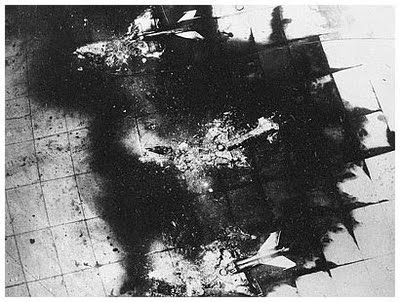
Egyptian Airforce destroyed on the ground

As a very young boy at Primary School, I vividly remember the Middle-East Six-Day War in 1967. Our school Principal announced at Assembly that he was deeply concerned about it leading to another World War and we should all pray. As a farm boy, I caught the local school bus, which in those days also delivered the mail, newspapers and bread to local farms. I distinctly remember glancing at the newspaper headlines and viewing the photos over that week of the newspapers that lay stacked at the front of the bus near the driver. Within a week the news vanished. Israel had defeated the Arab armies of Egypt, Jordan and Syria.

Next month it is 55 years since the Six-Day War.

Are there some lessons for managers from this significant historical event?

The war between Israel, Egypt, Jordon and Syria was fought between June 5 and June 10 1967 and resulted in an overwhelming victory to Israel and included the capture of the Sinai Peninsula and Gaza Strip from Egypt, the Golan Heights from Syria, and the West Bank and the Arab section of Jerusalem from Jordan. In summary, the war was a pre-emptive strike by Israel within an environment of mounting tensions with its Arab neighbours, where war unfortunately seemed inevitable. Israel was geographically challenged, lacked strategic depth, was politically and economically isolated and was numerically inferior in population and the size of its military.

So how did Israel succeed so spectacularly against such overwhelming odds?

Israel had been planning for war for many years, and central to this was the use of their air force. This involved a pre-emptive strike to destroy the Arab air forces on the ground. The plan had been worked out and practiced for several years with Israeli pilots flying repeated practice missions against mock Egyptian airfields in the Negev Desert.

At 7:14 a.m. the entire Israeli Air Force (IAF) of nearly 183 planes, with the exception of just 12 fighters assigned to defend Israeli air space, took off, flying under the radar with the goal of bombing 11 Egyptian airfields while the Egyptian pilots were eating breakfast.  Israel needed to destroy the Arab air force on the ground as their bombers could devastate Israeli cities. Amazingly, Israel had no bombers to use in the attack and the raid was carried out entirely by fighter planes. Most of Egypt’s planes never left the ground. By 11:05 a.m., 293 Egyptian planes were destroyed. Israeli fighters then attacked the Syrian and Jordanian air forces. By the end of the first day, most of the Egyptian, half the Syrian and all of the Jordanian air forces had been destroyed on the ground. By the end of the Six-Day War, the Arabs had lost 450 aircraft, compared to 46 for Israel.

So how was success achieved?

Logistics, superior training, planning and better intelligence.

The Israeli ground crews had practiced the rearming and refueling of returning aircraft. They achieved this in less than eight minutes, thereby enabling the strike aircraft of the first wave to fly in the second wave and meant an aircraft could fly five missions per day. By comparison, NATO aircraft could only fly three missions per day.

The IAF pilots were highly skilled and had been training for years. They practiced low level flying which required exceptional skills over the Mediterranean at under 30 metres so as to avoid radar detection. Furthermore, every pilot had photographs of their targets and had been practicing on mock targets in the Negrev Desert.

The IAF, using the “concrete dibber” anti-runway bombs which created huge craters made it impossible for the Egyptian aircraft to take off. This made the aircraft ‘sitting ducks’ and they were later destroyed on the ground.

Dawn was always considered the best time for an air attack from the east as the sun was in the defenders’ eyes. This was when the Egyptian air force was on high alert. However, Israeli intelligence found that 7.45 a.m. was when all the Egyptian air force was on the ground and the pilots were having their breakfast. This is when the IAF first attacked.    

Within six hours after the first IAF aircraft had soared into the morning sky, Israel had laid the foundation to winning the Six-Day War. Although the pre-emptive strike was a gamble, it paid off.

Careful preparation and some luck had been rewarded

What other lessons are there for managers here?

1. Planning – never underestimate how important planning is and doing your homework. The IAF did their homework on their enemies, knowing when they were most vulnerable and where the planes were located. Sound intelligence laid the groundwork for success.

2. Logistics – efficient use of available resources. The IAF was able to increase the utilisation of their aircraft well above what was considered ‘the norm’. Furthermore, as the IAF lacked bombers a new strategy of using bombs to effectively ground the rival air forces made them vulnerable to attack from the air by fighter jets.

3. Practice – leaving very little to chance the IAF practiced and practiced minimising the risk of failure. As the saying goes, practice makes perfect. There is no substitution for practicing to improve performance and increase the chances for success.

What other lessons do you think there are for managers?

#thenetworkofconsultingprofessionals

How do you improve your business processes?

Process improvement…

‘Without continual growth and progress, such words as improvement, achievement, and success have no meaning

 Benjamin Franklin – one of the Founding Fathers of the USA

Against a background of continual distractions, including increasing regulations and competition, one of the greatest challenges for businesses is to continue improve their performance and profitability. Improved processes lead to better efficiencies, improved productivity, greater employee satisfaction and, ultimately, profits.

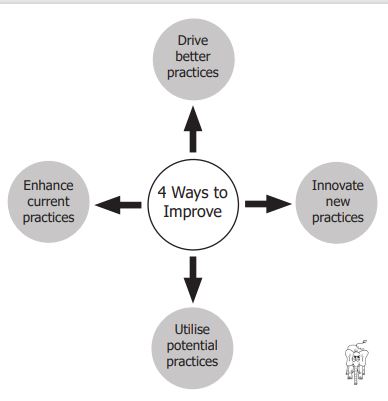
At its most basic level, there are four ways to improve productivity: 

  1. Drive better practices
  2. Innovate new practices
  3. Utilise potential practices
  4. Enhance current practices

Four Ways to Improve

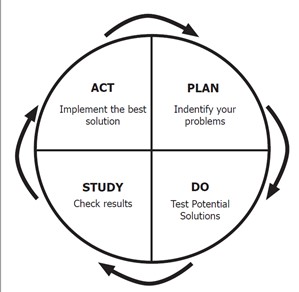
In Japan, following the devastation of World War II, the concept of ‘quality management’ was developed and implemented by an American – W. Edward Deming. He became known as the ‘father of quality management’ and his work led to the amazing success of Japanese companies such as Toyota, Sony and Mitsubishi. The ‘Deming management method’ became known as the Plan-Do-Study-Act (PDSA) cycle, which imbedded learning into a cycle of continous improvement.

Plan-Do-Study-Act (PDSA) Cycle

The aims of this section are:

  1. Describe how important process improvement is to a business
  2. Introduce a methodology we used to improve productivity in our logistics business.

Our third-party logistics business’s specific niche was retail logistics. When the business was first set up, it provided floor-ready merchandising services (FRM©) to retail suppliers. At that stage, the business was not a traditional warehousing and transport business – instead, stock was processed in the warehouse in a way that enabled it to be placed in each individual retail store in a ‘floor-ready’ condition, underpinned by an electronic commerce system. Items were price and security labelled, placed on hangers if required and scan-packed to store level.

This required a more varied skill set than traditional warehousing. The production process depended on the type of merchandise – whether apparel, shoes, cosmetics or electronics. This required a flexible approach and a standard methodology. Each supervisor would organise and ‘set up’ the job, and plan and manage the FRM© process. The productivity of each job and section was measured and reviewed individually with the supervisors on a weekly basis.

The methodology was called ‘the W5H Check’ because it asked why, what, where, when, how and who. Before each job was set up, the supervisor used this checklist to maximise productivity – answering the questions on the checklist. This approach improved productivity by  reducing the number of times the goods were handled, minimising lifting and walking, questioning who was doing the work,  eliminating unnecessary tasks and simplifying the process. 

W5H Check©

We found that this process improved productivity over time as it was decentralised, empowered the supervisors to make decisions, and measured performance. The supervisors were encouraged to seek input from their staff on how best to improve productivity and were authorised to communicate directly with the customers. It was similar to the PDSA cycle used in the Deming method and included specific questions that required thought. The W5H Check© sparked a process of continous improvement that was driven by ‘hands-on’ supervisors who were given the authority to make decisions that were the best for the customer and for the business.

The benefits of this system included very low staff and supervisor turnover, long-term customer retention and high levels of employee satisfaction. When the business was sold, the majority of supervisors had been with the company for over 10 years.

What are the areas in your business that you could improve using the simple Four Ways to Improve test?

Do you think that the W5H Check© system would be useful in improving productivity in your business?

Are there lessons to be learnt from the example above, relating to pushing responsibility down to supervisor level?

#thenetworkofconsultingprofessionals


What are the foundations of a good business?

What are the foundations of a good business?

“You can’t build a great building on a weak foundation. You must have a solid foundation if you’re going to have a strong superstructure”

Gordon B. Hinckley – American religious leader

Deciding to go into business is the first step. The second step is to ensure that from the beginning the business has solid foundations. This is critical and is relevant whether your business is a start-up, or you are purchasing an existing business. Like a building constructed on solid rock, a business with a solid foundation will have a better chance of surviving the inevitable challenges, than one built on unstable foundations. Cracks will inevitably appear in a business over time, as they do in a building. By solid foundations I don’t mean a market niche, systems and processes, skilled employees and loyal customers which can be easily found in ‘how to’ management books, and on the internet.

When my partners and I were going into business, it involved a management buyout of an unprofitable business. We were eager to ‘have a go’ on our own and prove we could build a successful business. This leap of faith meant mortgaging our houses to raise the capital, not an unusual practice for funding new businesses. This certainly focussed our attention. Failure could mean losing the family home and all the implications associated with family life.

As with an elephant’s legs supporting the world’s largest land animal, having a solid foundation on which to build and support a business is essential. Luckily the previous owner had an excellent financial director who provided us, with some practical and useful advice;

”Protect your assets and limit your risks and liabilities”.

We also sought advice from external experts. As owners and managers, we didn’t know what we didn’t know. Seeking external expertise is essential. From our experience in setting up in business, the disciplines where external assistance is required in the following disciplines:

  1. Legal advice in setting up the business’ legal entities, including each owner’s private company which were shareholders in the business, establishing corporate structures that reduce the exposure to legal claims from avaricious ambulance chasing lawyers, completing shareholder’s, agreements, terms and conditions and suppliers’ agreement.

One of the lessons learnt was whilst the structure of the founding team set out the entitlements of each founder, we did not clearly outline our roles and responsibilities which lead to. performance and accountability becoming issues and was complicated by two family tragedies. This could have been managed more effectively if roles and responsibilities had been more clearly set out and a company board that held the executive team and founders to account had been established.

  1. Financial advice from a chartered accountant on business related finance issues, including insurance, taxation, banking and recommended corporate structure in combination with legal advice .

The main lesson learnt was to separate the business entity from personal affairs is essential. Unfortunately, I have witnessed some businesses getting into financial difficulty by not separating private and business affairs as well as a lack of discipline and  no clear understanding of the importance of keeping this separate. This is particularly relevant to family businesses.

  1. Strategic business advice from an advisor with business owner experience. There are two issues here;
    • seeking external advice
    • ensuring it comes from a consultant or advisor who has practical experience in managing and owning a business.

Too often there are consultants who do not have this experience and do not understand what it is like to have their money and house on the line.

In retrospect we should have sought in our logistics business external assistance in strategic planning.  Our annual budgets were built from the ground up and served as our business plan. The weakness became apparent in the vital areas of values, vision and a mission statement which underpin the budgets and business plan. These were missing. We did not recognise their importance. Values, vision and mission statement were only created when we established a webpage. We would have benefited immensely from engaging an external advisor earlier in the piece. The business although profitable would have been more profitable and would have developed more strategically. Professional external advice would have opened up opportunities through identifying strategic long-term customers, obtaining government grants and developing new networks.

In conclusion, the message is seek advice from those with expertise so the business has solid foundations, so when inevitably the storm comes the business has a greater chance of survival. Seeking external advice is not a sign of weaknesses. Elite athletes and sporting teams all have coaches. A business is no different. Also as a manager and business owner, on-going education is essential for continual success.

#thenetworkofconsultingprofessionals

Management lessons from the sinking of the Bismarck

Management lessons from the sinking of the Bismarck?

“Sink the Bismarck”

Quote attributed to British Prime Minster, Winston Churchill in 1941

Just over 80 years ago this month, the Bismarck was sunk.

What was the Bismarck?

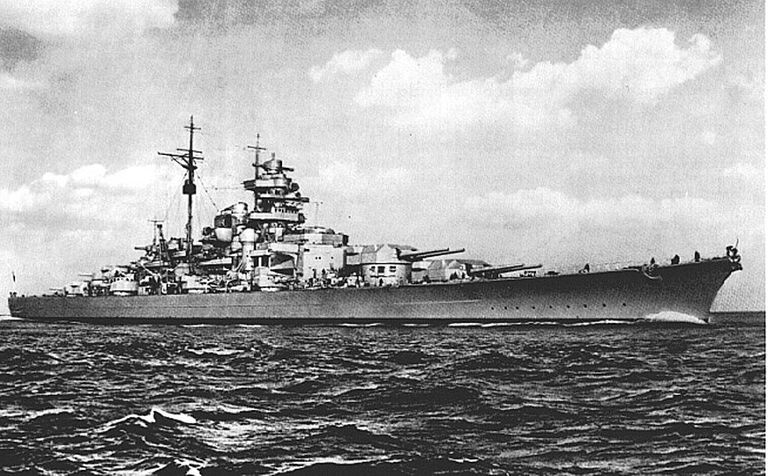
The Bismarck was a World War II German battleship. With over 2000 sailors, it was the flagship of the German Navy and was the largest battleship then commissioned. In late May 1941, the recently launched Bismarck and another German warship, the Prinz Eugen evaded the British Navy and escaped from the Baltic Sea into the Atlantic Ocean. Their mission was to destroy as much Allied shipping as possible, and together with the U-boats, force the suspension of the supply convoys from the USA, vital for Britain’s survival.

The Bismarck was the most advanced battleship at the time. More modern, faster and more heavily armed than any ship in the British Navy. The Bismarck had a special anti-torpedo belt made of nickel-chrome steel. The Germans believed that no torpedo could penetrate the shield and were convinced that the Bismarck was almost unsinkable. Furthermore, the Bismarck had a sophisticated anti-aircraft fire control system to protect it from attacking aircraft.

The British Navy sent the flagship of the Home Fleet and their largest warship, the HMS Hood and another ship the Prince of Wales to hunt down the Bismarck. In the ensuing battle in the North Atlantic, the Hood was sunk within three minutes and over 1400 sailors lives were lost. Only three survived. The loss of the Hood was a significant blow to British morale. Although also hit, the Prince of Wales managed to damage the Bismarck before retreating from the battle. This forced the Bismarck to abandon its raiding plans.

The British Prime Minister Winston Churchill then issued the order “Sink the Bismarck!” and the relentless pursuit of the two German warships by dozens of British Navy ships began.

The damaged Bismarck, leaking oil, limped towards Nazi occupied France where protective air cover and a destroyer escort were waiting. However, by a stroke of luck an RAF Catalonia flying boat sighted the Bismarck’s oil slick and reported her position. From then on, the British Navy used radar to track it and over a dozen warships followed the battleship.

One of the British ships shadowing the Bismarck was the aircraft carrier Ark Royal. On it were 16 obsolete open cockpit Swordfish bi-planes. With time running out, and with the Ark Royal being the closest ship to the Bismarck it was decided to attack the Bismarck from the air. In atrocious weather and in the fading light the slow-moving Swordfish attacked using torpedoes. Bismarck’s sophisticated anti-aircraft guns were too advanced to shoot down the slow-moving bi-planes. In the final attack, a single torpedo hit the Bismarck’s rudder and steering gear, and from then on it was unable to maneuver. It could only steam in a wide circle.

Unable to repair its rudder and steaming in a circle the Bismarck was doomed. The next morning the British Navy opened fire on the crippled battleship. With its large guns partially out of action, and unable to maneuver, the Bismarck was sunk within two hours, on its maiden voyage, with the loss of over 2,000 men.

What do you think are the management lessons from the sinking of the Bismarck?

Here are three lessons to consider.

1. Do not rely on technology.  The Germans considered the Bismarck as virtually unsinkable with superior firepower, advanced torpedo shields and sophisticated anti-aircraft guns. However, the low-level technology of the Swordfish bi-planes managed to cripple the Bismarck.

2. Technology is an enabler. It indirectly resulted in the sinking of the ship. The British used radar, which was a very new technology to track the Bismarck. Without it, the Bismarck would have escaped to the safety of Occupied France.

3. Persistence pays off. Despite the superiority and perceived danger of the Bismarck to Britain and its navy, a well-planned and persistent chase managed to find and sink the Bismarck. Furthermore, in the dying light in atrocious weather and against all odds, a single outdated Swordfish bi-plane managed to damage the Bismarck just when it looked like the Bismarck would escape the Royal Navy.

What other lessons can you find?

Remember: We can learn from history.  The use of well-known historic examples helps paint a more vivid picture and storytelling helps communication.

Can we learn anything as managers from the 1975 film, Monty Python and the Holy Grail?

Can we learn anything as managers from the 1975 film, Monty Python and the Holy Grail?

“I am invincible!” said the Black Knight

This British comedy film concerns the legend of King Arthur travelling throughout Britain seeking men to join the Knights of the Round Table in the search for the Holy Grail.  In medieval British legend, the Holy Grail was the cup that Jesus used at the Last Supper. Beliefs at the time said it could heal wounds, deliver eternal youth and grant everlasting happiness. Today, it is a term used to describe a goal or object that is elusive and can never be found or achieved.

It is one of my favorite movies which I must admit I have watched at least 10 times and has a cult following. In watching it again last month, I realised that it had some important lessons for us as managers.

  1. The Black Knight. 

King Arthur approaches the Black Knight who says: “none shall pass”. Despite pleas to be reasonable King Arthur is forced into a joust, resulting in the Black Knight losing all his limbs in the ensuing sword fight. He refuses all offers by King Arthur to cease the one-sided contest. One of my former business partners refused to accept that a manager was having detrimental effects on morale and profitability, despite being presented with the facts. It was only when the partner went on holidays that we were able to take action and dismiss the manager.

What is the lesson for managers here?

Clearly, the stupidity of the Black Knight resulted in him losing all his limbs. Stubbornness, refusal to face facts, bloody mindedness, denial and continuing poor decision making is not a sound managerial strategy. Managers should be realistic when confronted with facts, however unpalatable.

  1. The Man called Dennis. 

King Arthur approaches some peasants on the way to a castle on the horizon and mistaken calls one of the peasants an “old woman”. He then makes excuses for not knowing the peasant’s name (Dennis), age (not old he’s 37) or the fact that he was a man.

Can you spot the poor management here?

Managers should make the effort to know their staff. It’s the attention to detail and often the small things that are important and appreciated. I remember witnessing a manager whom the staff had no respect for walking around a warehouse pretending to know their names and be interested. It became a game to get him to call the person the wrong name.

  1. The Rabbit Cave

King Arthur and his Knights are directed to a cave by Tim the Enchanter. Inside the cave are the directions to the site of the Holy Grail. The entrance to the cave is littered with bones and is guarded by a killer rabbit. Tim warns the Knights that rabbit is a killer and they ignore his advice. They choose to ignore, they attack, which results in the deaths of several knights.

As managers, what can we learn here?

Why did the Knights attack despite being warned and seeing the bones outside the cave? Because they didn’t listen to advice and ignored the evidence. Often as managers we make these fundamental errors, sometimes because our egos get in the way or we don’t wish to face the facts. When managing a transport business, I remember discounting the option that theft from motor vehicles was occurring in our depot even though the evidence seemed to suggest otherwise. A private investigator proved me wrong

In conclusion, the final lesson is within the film itself. Faced with budget constraints, the use of real horses was deemed prohibitive. Instead the Knights ‘travel’ on invisible horses with the sound of the horses’ hooves clopping coming from the clapping coconuts. The idea came from an old radio technique of  using coconut halves as sound effects for horses. Yes, as managers we should all be prepared to compromise, improvise and find solutions that could be just as suitable and more affordable. In our logistics business we were confronted with excessive waiting costs at a retailers’ distribution centre and could not recoup the costs. After some experimentation initially with shipping containers we negotiated a drop-out system for a van trailer, thereby eliminating waiting time and significantly increasing our returns.

#thenetworkofconsultingprofessionals