Is marriage like running a business?

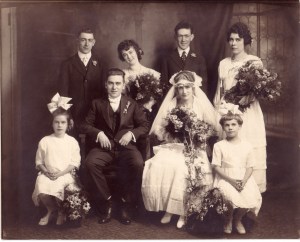
Leonard (Linky) Jensen I (1887-1979) at the wedding of Daisy Jensen (1892-1986) and Francis (Frank) Joseph Woods (1891-1972) in 1918 in Chicago, Cook County, Illinois.

Is marriage like running a business?

“A successful marriage is an edifice that must be rebuilt every day”
Andre Maurois – French author

Today is a very important day for me. It is my 30th wedding anniversary – a time for great celebration and reflection. I am truly blessed having shared the past 30 years with my wonderful wife in a great marriage with all its joys and challenges.

Can lessons can be learned from a great marriage that can be applied to managing a successful business?

Yes, there are many………

Here are just three lessons from a successful marriage that can be applied to business.

Lesson 1: Communication

Continuous two way frank and honest communication is the hallmark of a successful marriage. Problems can be aired, solved constructively and the future discussed. It is the same in business – communication with staff, between departments and with customers provide the mechanics of a successful business. Goals and successes can be shared and problems solved. Communication is about caring and sharing. Customers and staff do not want to be left ‘in the dark’. Two-way continuous communication helps ensure staff and customers feel valued and are committed to you and the organisation. Too often we become complacent and fail to communicate regularly. I can remember some years ago a situation where I increased the rates to a customer without communicating the reasons. They immediately sought competitive proposals and then advised us they wanted to leave. Luckily our Operations Manager was able to remedy the situation by discussing the reasons for the increase only to find that the order and customer profile had changed significantly and the rate schedule was now no longer suitable. Frank two way communication had not occurred, we did not know the profile had changed and we had not advised the reasons for the increase. It was a lesson learned.

Lesson 2: Commitment

Any relationship or partnership is not all smooth sailing, whether it is managing a business or a marriage. For example, challenges are thrown up on the marriage journey that must be faced. Many are outside our control. Reflecting on the past 30 years of our marriage we had to face the challenges along the way. Whether the challenges were family issues or geographic isolation from family and friends, we were committed to making it a success. The same can be said for businesses. If you are committed in managing a business effectively or growing a business you need to meet the challenges as they emerge. Often in business we face crises that could destroy the business. I can remember a situation when a customer owed us over $350,000 and claimed they could not pay. If they failed to pay, our business would probably have been destroyed. Luckily through commitment in enforcing a payment plan we were able to get the money owed and save the business.

Lesson 3: Celebration

Too often we do not celebrate what is important, whether in business or in a marriage. Celebrating our marriage success such as anniversaries or milestones.

Business is no different. Looking back in our business we rarely celebrated successes such as winning a new contract. Later we found out that staff wanted to know our success and suggested we should celebrate with a BBQ or luncheon. However we did recognise staff service and made a big deal about its importance. Our business had staff that had been with us from the beginning and were still there 15 years later. We celebrated this by presenting awards and a gift at our annual management conference.

As the quote from Andre Maurois suggests success in marriage is about continuously rebuilding. The same goes for managing a successful business.

Communication, Commitment and Celebration is a good start. Complacency leads to stagnation and more often than not, failure.

What are your plans to continuing improve your organisation and business?
Business continuity …do you have a plan?

elephant in room - 2

Business continuity …do you have a plan?

What would happen if you did not turn up to work today?

This is a very important question for business owners.

Would your business continue to operate?

Can it continue to grow and can you sell it?

In a recent bog, I wrote about my friend Tim Boyle, Australia’s first kidney lower intestine transplant recipient and his positive attitude in the face of a seemingly impossible situation. This helped him get through a complex and lengthy surgical operation and be out of hospital in five weeks. At the time of writing this blog Tim is recovering well.

As a finance broker, he was passionate about providing people with opportunities to own their own home. Over the long years while he was waiting for a suitable donor, Tim continued to build his business and put in place contingencies for the business to operate without him. Whilst recovering in hospital he talked to staff at all levels explaining how important it is own your own home. I witnessed nurses coming up to him and thanking him for giving them hope. His business continued to operate.

However the real message was that his business continued to operate whilst ‘not being there’. His staff of two continued to work without him being there.

Why?

Because there was a business continuity plan – it could operate without Tim, the owner being present.

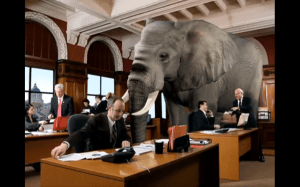
This is one of the biggest issues for small to medium sized (SMEs) owners – the elephant in the room. Would your business survive without you coming into work?

If your business cannot operate without you, then your business is vulnerable. This goes to the next step. Should you wish to sell your business in the future, and the business is dependent on you on a daily basis then the value to a potential buyer is significantly lower.

The following link summarises how it is important to be a ‘leader’ rather than a ‘doer’, otherwise your business cannot operate (or grow) without you.

Putting it bluntly, the first step is to put your ego aside and plan to have your business operate without you……………you can go on holidays, be absent, protect your wealth, family relationships and your health.

You have nothing to lose and everything to gain………….

Three things my mother taught me about business…

Mom's_Rule_04

Three things my mother taught me about business…
My mother taught me to appreciate a job well one – “If you’re going to kill each other do it outside – I have just finished cleaning!”
 Anon

In Australia Mother’s Day is in May. This is the day that you should thank your mother and reflect on what a wonderful person she is. Apart from appreciating a job well done what else did your mother teach you?

As a business owner and manager can we learn from our mothers?

My mother was a school teacher, a city girl who married a farmer in rural New South Wales in the 1950s. This was probably not the life her father, a senior public servant had envisaged for his youngest daughter. Perhaps this background helped her in teaching her sons about life.

Here are three things my mother taught me that have helped me in business.

  1. Strong work ethic

My earliest memories of my mother were of her looking after her four sons and making significant sacrifices. Mum went back to work when my youngest brother went to school primarily because her income would help support and educate our family. The uncertainties of rural life with droughts and low commodity prices meant ‘off farm’ income was essential. She would drive off every day to teach, come home do her domestic chores and then plan and mark schoolwork well into the night. This hard work had its own rewards; providing an education for her sons, satisfaction of educating and inspiring the children she taught and providing financial stability for the family. There is no substitute in business for hard work with a clear goal in mind.

  1. Perseverance

Rural life is often hard and at times an unrelenting grind as the lines in the Eric Bogle song “Now I’m Easy” say

“Of droughts and fires and floods I’ve lived through plenty

This country’s dust and mud have seen my tears and blood”

Through the heat, the droughts, low prices, flies and dust Mum persevered supporting Dad, and providing physical, emotional and moral support to the family. Mum would say, ‘Put your back into it and keep going’, and I’ve taken this thinking into business. Even if the worse appears to have occurred, stay calm, focus and carry on. Don’t sweat the small stuff, and don’t get caught up in the crisis. With focus and hard work, it will pass.

  1. Fierce self-reliance

My mother was fiercely hard working, independent and had a strong sense of self belief often introducing new ideas into a conservative rural community. She instilled in all her sons these qualities of independence and self-belief with a strong emphasis on the value of education. When you’re young and starting out in a new job or a new business it can be hard to remember in the face of critics, how important self-reliance is.

So on Mother’s Day think about what your mother taught you when you were growing up and thank her. Mum’s qualities taught us to trust in our decisions and do not hide from our mistakes. As Mum would say:

“It’s not the mistakes you make, but how you deal with them”

implying that a high work ethic, perseverance and fierce self-reliance will see you through.

As a business owner or manager can you use the qualities your mother taught you to improve your business?

Constant renewal – lessons from the farm

Bathurst-Burr-2

Constant renewal – lessons from the farm

I grew up on a farm in north western New South Wales, Australia. In my opinion it was one of the best groundings in life you can have. Many things observed and experienced as a child growing up on the farm can be related to business.

One experience that comes to mind is the problem of weeds.  This can be related to continuing to improve both your management performance and your business.

On our farm, weeds, specifically burrs and thistles were a major problem. In particular there was a burr called a Bathurst burr. Bathurst burr is amongst the most common and economically serious weeds in Australian agriculture. It readily adheres to the wool of sheep. Wool contaminated by Bathurst burrs is a substantial cost to the wool grower as additional processing is required to separate the burrs from the wool. The burr was first introduced to the city of Bathurst, Australia’s first settled inland city in about 1850. It was trapped in the tails of horses imported from Valparaiso in Chile. Perhaps it should have been called Chile burr!

As my father was a woolgrower, Bathurst burr was a major issue.  As children we were often sent out with a hoe to chip Bathurst Burr along the outside of the cultivation paddocks and roadside. Call it character building. However, compared to other properties in the district our farm had relatively small amounts of this burr.

Why was this so?

It was not from our childhood efforts chipping weeds along the roadside!

It was due to my Dad, who was constantly on the lookout for burrs. When horse riding whenever he saw a Bathurst burr, he would dismount from his horse and pull it out. As children we were fascinated by this obsession of eradicating Bathurst burrs and would often point them out to him if he missed one (this was very rare as being an Aussie bushman he had excellent eye sight).

By comparison, my school friend Graham who also lived on a farm had a different experience. I can remember his father’s place having far more burrs than ours. Like my father, his father would often send him out chipping burrs. However, his father became ill, involving hospitalisation and was unable to walk around his farm and keep burrs under control.

What was the difference?

It was because of the constant attention to keeping the burrs under control – often on a daily basis.

And this is the lesson for managers and business owners. Managing is not about platitudes, big schemes and projects. It is about constant attention to detail, continuing seeking ways to improve……… everyday.

As a manager are you keeping the burrs in your organisation under control?

Nothing is easy…

Donald Trump

“Nothing is easy”

Donald J Trump US President

As much as I object to Trump’s mindless self- promotion and gigantic ego, his statement above rings true for those of us who strive to improve our businesses and careers. Unfortunately today with instant electronic communication, we hear stories of “overnight success” that implies it’s easy to be successful. Poor research (may be its no research) light weight and lazy journalism and the perceived need for ‘instant’ gratification or success spread this expectation. Most of these overnight success stories are the result of hard work and sacrifice. Think of JK Rowling the writer of the Harry Potter books who as a single mother on social security benefits, spent years writing, often in an Edinburgh café before her first novel was accepted.

The only example of instant success, apart from winning a massive lottery draw I can think of is the story set in 1960s about Sir Frank Packer, millionaire media owner and father of Kerry Packer. The story goes that Sir Frank, in finding himself in an elevator of his Sydney office building along with a shabbily-dressed man, is outraged. Packer tells the man he’s a disgrace to his firm, fires him, and hands him $1,000 to buy a new suit. The ‘fired’ man just grins — he’s actually a freelance photographer who stopped by to visit a friend who worked in the building. 

Malcolm Gladwell in his book Outliers: The Story of Success introduces the idea practice (or hardwork) which he calls the 10,000 hour rule, makes perfect, and success is not due to the random distribution of genetic gifts or luck. He uses examples of The Beatles and Bill Gates whose success he attributes to the 10,000 hour rule of music and computer practice combined to a much lesser extent with opportunity.

Think of successful people around you, whether in business or in society. Almost always their success is the result of hard work and focus over many years.

I can remember doing post-graduate studies, working a 12 hour day in a demanding job with a 3 children under 5 years old and wondering whether it was worth the sacrifice for my wife and I. It was. It led onto lecturing at university, being head hunted for a job and ultimately into our own successful business.

As Donald Trump said “who wants nothing”…………….

As I tell my children………….the only place where reward comes before work is in the dictionary.


A New Beginning

Tim

A New Beginning

‘To say it is life changing is an understatement — it is a new life, not life changing’

Tim Boyle (Australia’s first kidney and lower intestine transplant recipient)

This is a quote from colleague and friend Tim Boyle, who became Australia’s first kidney and lower intestine transplant recipient in October, 2015.

Twelve years ago Tim received the news that his lower intestine was no longer working and had it removed. Although he could eat, he could only process 10% of his intake as nutrition and had to be fed via an intravenous drip. Less than 2 years ago his kidneys failed which meant each week he spent up to 50 hours attached to medical machines.

You can read his story in the links in the website Daily Mirror and on SBS.

Despite these setbacks, Tim remained optimistic for the future and was committed to his young family and continued to build his business. Although he had time to catch up for coffee, produce a monthly newsletter and write a book we noticed a slow decline in his health and in the last few months this became a rapid decline. Although he acknowledged this decline we ‘outsiders’ noticed a more rapid decline and feared for his future.

Tim’s journey and his quote got me thinking. How does this relate to business?

Many businesses are like Tim’s health. Slow decline not noticed by those in the business, whether it be the owners or employees but noticed by those outside. Complacency and accepting the current situation in business can be fatal. This can catch up on you without realising the true situation and can result in business failure.

It’s now January and the start of a new calendar year and it is time as Tim stated “it is a new life”. In Australia, January is the summer holiday period where staff are either on holidays or tend to be more relaxed. For business owners and managers it is time for reflection on the previous year and to plan for the next. Time for a new beginning…………

So what should you be doing?

What you should not be doing is relaxing and allowing the status quo to continue……it could be fatal to your business.

Here are some 5  suggestions to get you thinking (and acting!)……….

  1. Learn lessons from last year – write down what you have learned, good and bad and act on them for the next year
  2. Set goals for the next 12 months – write them down, be positive and ensure they are realistic and will make you look back in 12 months with a sense of achievement
  3. What bad habits should you eliminate? – we all have bad habits that if we change will make us, our staff and customers more productive, engaged and motivated
  4. Thank your staff and customers – in particular those who helped you and the business in the past year. Hopefully you would have done this before Christmas
  5. Clean up anything left over from the previous year – there is nothing better than starting the new year with a ‘clean slate’. Leftover tasks stop you moving forward with energy and enthusiasm for the new year deserves.

So let January be a period to commence the new year with a positive plan and outlook for the next 12 months, leaving the old year behind…………..

And think of Tim and remember this year is an opportunity for ‘a new life’………..

Post Note:

If you haven’t done so, why not consider becoming an organ donor? It is really easy to do but unfortunately most people don’t only because they haven’t thought about it. In Australia we have long waiting lists due to lack of donors and it truly saves lives. Tim waited 4 years and was unlikely to see Easter. Luckily ground breaking surgery with a different donor blood was successful.

Go to www.donatelife.gov.au for all details.

Christmas…its that time of year again

Xmas

Christmas…its that time of year again

“The thing about Christmas is that it almost doesn’t matter what mood you’re in or what kind of year you’ve had – it’s a fresh start”

Kelly Clarkson – American song writer and philanthropist

As business owners and managers, the Christmas period can be either a period of joy and celebration or a disaster.

Every year we hear stories of work Christmas parties that go wrong…..drunkenness, inappropriate and embarrassing behaviour, work accidents and the like. Often management or the organisation is blamed for the outcomes. It all the more disappointing when it is traditionally a period of cheer and goodwill. In Australia it is also the start of the summer holiday period so generally everybody is in good spirits.

The Christmas party provides a great opportunity to build on the season of goodwill and to say thank you. Any manager who does not take this opportunity has failed as both a leader and a manager.

I can remember a Christmas Party where the staff looked forward to the event, bringing their families including children and grandchildren to enjoy the jumping castle, rides, ice cream and soft drinks. The free raffles were always fun until the business owner’s numbered ticket was picked from the barrel. He promptly walked up and collected his prize. His managers were horrified and embarrassed because it displayed a lack of self-awareness and leadership. They also witnessed the negative reaction from the staff and their families. A better option would have been to say “draw the raffle again” – putting your staff and families first and showing that you are a leader.

Another example was related to me by a friend. At their staff Christmas party, the CEO came down and had her meal, chatted briefly to her general managers before disappearing back to her office. All without thanking staff for their efforts or wishing them all the best for the Festive Season. This was left to her deputy. This total lack of leadership was noted by the staff attending. If you do not show respect to your staff it will not be reciprocated. A quiet and sincere speech of less than a minute would have given quite a different outcome.

So what should you as a manager do for your staff at Christmas?

Celebrations aside, the traditional period of goodwill is an excellent opportunity as a manager to ‘rise to the occasion’ and display leadership. Talk to all your staff and their families. Display graciousness and sincerity about your staff’s efforts. Wish them the best and paint hope and opportunity for the future. It is a time for renewal and evaluation so take advantage of this great opportunity………..

And to all the readers of this post, thank you for reading my posts and I wish you and your families the compliments of the Season and best wishes for the New Year.

Exit Strategy…

Kerry Packer

Exit Strategy…

“Always have your business ready for sale. You might not get more than one chance. Not everybody gets an Alan Bond in their life.”

Kerry Packer (late media owner and billionaire)

The late Kerry Packer sold his TV business to corporate raider Alan Bond for over $1billion in 1987 (far more than it was worth) then bought it back 3 years later for $250million. He was not expecting the sale but sold because it was too good an offer to refuse.

“Begin with the end in mind”. This is habit 2 in the late Steve Covey’s Seven Habits of Highly Effective People and it is important when you start or buy into a business.

What is your end game?

What do you want to achieve and where do you want to be in ‘X’ years’ time?

I bought into a business over 15 years ago with 3 other partners. In purchasing the business, the seller who was our former employer advised us to have an exit strategy with a time limit. This was noted and promptly forgotten.

As the business grew there were the usual tragedies and triumphs.  After 10 years I suggested we needed to get the business in a ‘sale ready’ condition. However with business partners with differing priorities this did not eventuate. It’s not that we needed or wanted to sell the business, just that it was because, like the late Kerry Packer said “You never know when a buyer will come along”.

Without warning a potential buyer did come along and we were not ready. It was a disaster. The potential purchaser viewed a somewhat disorganised and business and quickly lost interest.  An underlying issue was the lack of a shared vision in the management team and unclear agendas.

Did we learn anything from our first approach by a potential buyer?

A little bit, but not enough………..

Less than 2 years later we were approached by a large multi-national company wanting to buy the business. This time were a little better prepared. The negotiations dragged on for over 9 months and eventually it failed for a number reasons. These reasons included legal complexities to do with selling the business versus selling the company (this had significant financial implications), the final offer and performance guarantees.

I was disappointed that we had missed another opportunity.  At our debriefing meeting, I identified what I believed were the reasons for the sale falling through:

  • no professional assistance from a corporate advisor (the potential purchaser had an entire M&A department),
  • no legal or tax advice
  • no timeline.  

There were however, some positives that came out of this experience. The business had now been ‘tidied up’ and was in a more saleable position. After considerable discussion, it was then agreed to engage an advisor, seek financial and tax advice and agree on a timeline should a buyer emerge.

The engagement of the corporate advisor was critical. They helped take the emotion out of the process, kept to the plan, prepared professional sale documentation, co-ordinated the various parties including the accountant and lawyers and sought out potential buyers. The business was sold successfully to an offshore company with conditions and a price that far exceeded our expectations.

Our Alan Bond moment.

The corporate advisor uncovered and highlighted the Value Drivers of the business. For further insights into exiting a business I recommend reading a blog by exit expert Kerry Boulton.

In hindsight, perhaps the failed sales helped us……….you can be lucky and learn from your mistakes.

So is your business ready for sale (and are you?) just in case an ‘Alan Bond’ comes along with an offer too good to refuse?

Can see but am blind?

Man with covered eyes

Can see but am blind?

“If one can see things according to one’s own belief system, one is destined to become virtually deaf, dumb and blind”

Robert Anton Wilson (author and futurist)

 How often as managers have we been unable to see what is obvious and have been blinded by our own prejudices?

Have you ever been looking for something and even though you have been told where to look and you still cannot see the object even though it is front of you?

This is because you have a pre-conceived idea in your mind of what you are looking for so you discount anything that does not meet what you are subconsciously looking for.

I can remember quite clearly being blinded by my own prejudices whilst managing a trucking operation. The business distributed motor vehicles. Over several weeks we had been receiving complaints of personal items being stolen from the vehicles. Initially I was convinced that it was occurring in other transport depots as we were the hub distribution point. The thefts continued and I still blamed the other depots. My fellow managers implemented theft prevention strategies and still the thefts continued and seemed to be increasing. Many of the items seemed to be of little value. The night supervision team claimed it was impossible that this could be occurring under their watch.

I was still convinced it was occurring elsewhere. Then one of my staff suggested that perhaps it was happening under own very own noses!

We set up a sting the next night, involving the police and a private investigator. Imagine my shock when two drivers working in our depot were caught on camera stealing from a car. All the time I had been blinded by my personal prejudices – the culprits like the object in the cupboard were there all the time.

This example demonstrates an important characteristic of good management. Review all the possibilities, consider them carefully and don’t make decisions based on emotions or preconceived ideas……………

Managing your emotions

Managing your emotions

“If your emotional abilities aren’t in hand, if you don’t have self-awareness, if you are not able to manage your distressing emotions, if you can’t have empathy and have effective relationships, then no matter how smart you are, you are not going to get very far”

Daniel Goleman (originator of the term ‘emotional intelligence’)

Does expressing your emotions openly in business help serve your goals or your company’s goals? In my opinion, it depends on what emotions you are expressing, and whether they are negative or positive.

Many years ago upon finding out that my manager had sacked a colleague, I confronted him. I believed his actions were unjustifiable and were to cover up his own incompetence and failures. On display were my negative emotions which are destructive and de-habilitating. It was not a wise action. It showed my lack of control and self-awareness and these actions indicated that I was not management material either. Furthermore, I didn’t know if burning this bridge would have negative impacts for me in the future.

Do you really think that your bridge-burning, fire-breathing rant is going to change things? That company management will suddenly come to their senses?

No.

I actually learnt from this mistake and vowed to hold my tongue and display more self-awareness and professionalism in the future.

Years later I experienced a similar situation when two managers were using me as a scapegoat for the business not performing and recommending my termination. Upon hearing this I decided on a positive approach rather than being confrontational and burning my bridges. Positive emotions are liberating and invigorating. Think of people you work with who are positive and enthusiastic. They get things done. People follow them. People like working for them – they are leaders.

Luckily I built up constructive relationships with others in the company and with clients and my position was saved, whilst they were forced from the business. Less than 3 years later, one of them came to me with a very large potential customer for our own logistics business. We were successful in securing this customer and it helped underpin the business and formed a foundation for the business to grow.

This business saving opportunity would not have happened if I had burnt my bridges……….