Using visual symbols to communicate…

82 Overcrowded Bus.

Using visual symbols to communicate…

“The best leaders… almost without exception and at every level, are master users of stories and symbols”

Tom Peters – Business Author

I have just arrived back today from travelling in Africa …..

We often hear business leaders and politicians trying to communicate messages unsuccessfully. Why?

Are they using too many words, the wrong words or just words? Communication is not just verbal. It is estimated that over 65% of all communication is non-verbal. Eye contact, facial expressions, appearance and gestures influence how you interpret the message.

This is where the use of symbols become important in communicating. This can be used in the workplace.

Recently I was confronted with trying to express the importance and urgency of cultural change to an organisation that was underperforming. Presenting to the Board I realised that the use of symbols or visual imagery would help communicate the issues and how to manage the change.

The visual imagery I decided to use was taken directly out of Jim Collins’ management book, “From Good to Great – why some companies make the leap and others don’t”.

I used the symbol of a bus. The symbolism was very easy to understand and is very clear.

From a PowerPoint slide showing a red bus presented to the Board, the concept developed to using a model of a toy bus. The bus had the company’s logos on the side, and on the roof was an arrow pointing forwards indicating progress and moving ahead with the Jim Collin’s quote:

“Get the right people on the bus, the wrong people off the bus, and the right people in the right seats”

The toy bus sat on the meeting room table for all to see. Later we added Lego people getting on and off the bus – normal people getting on, and pirates, wizards and clowns getting off the bus. The toy bus was regularly referred to when explaining a person’s performance or suitability and became a clear way of communicating.

Staff were often asked: “Are you on the bus?” and ‘Are they on the bus?”

It became a powerful visual symbol. When management spoke about what needed to happen it was described in terms of being on the bus. It was a clear message and was understood from the managing director to the staff on the shop floor.

We implemented daily ‘toolbox’ meetings with staff. We called the location ‘the bus stop’ further reinforcing the message.

Using symbols in business as a tool is a very important part of communicating, both with your current and prospective customers and staff. If the symbol is compelling enough it will become part of the organisation’s culture.

Can you think of a symbol used by an organisation that is easily recognisable and understood?

What about your organisation?

Visualising your goals…

IMG_3092

Visualising your goals…

“If I could have seen France, I would have made it”

Francis Chadwick: long distance swimmer

 Francis Chadwick was the first woman to swim English Channel in both directions. Her first attempt failed after spending 14 hours in the water. The attempt was made in thick fog and ironically she was only 3 miles from France when she abandoned her attempted crossing. Her comments on finding out how close she was to her goal was:

“If I could have seen France, I would have made it”

There are few better examples of the importance of setting goals and visualising those goals. Last month I was trekking in the McDonnell Ranges near Alice Springs in Central Australia. Not only was it an amazing visual experience but it was also a time to reflect and enjoy the company of interesting people, as well as the physical challenge. Each day we set out to walk the 18 to 20 kilometres in a harsh desert environment. This meant setting goals for the day.

On our second day we got up at 5.30 am and trekked 8 kilometres through a gorge over rocky and steep terrain onto open spinifex covered slopes to the summit of Mt Sonder. This mountain was the highest point on the Larapinta Trail with 180 degree views over 100 kilometres of the surrounding country.

At times it was physically quite difficult however it was made easier as we had a goal. We could see the mountain in front of us. Unlike Francis Chadwick’s first attempt at swimming the English Channel we could see our goal and kept going. The magnificent views were one of the rewards for our efforts.

Everybody should have goals whether it’s to obtain a degree, be financially independent, buy your first house or start a business.

Without clear goals you are less likely to achieve your potential or anything else for that matter. Too few of us set goals in life or in our work. Importantly, by not having written goals we are even less likely to achieve our potential.

The alleged quote from Lewis Carroll’s book Alice in Wonderland explains the situation clearly:

“If you don’t know where you’re going, any road will get you there”

However, I have found that although writing down goals is important it is critical that you also have a plan with milestones to help you meet your goals. In climbing Mt Sonder, we had various milestones to reach certain locations by set times to ensure we climbed it in the time planned and to complete our descent before the heat of the afternoon set in.

In concluding one often overlooked part of goal setting is to visualise your goal. I have found that visualising what the completed goal is a powerful motivator. In selling our business I visualised what it would be like to finally be rewarded for all that hard work

……….a bit like climbing Mt Sonder where we visualised the spectacular  views and enjoying a well-earned rest. To be able to see the mountain helped with the visualising the goal. Francis Chadwick in her second and successful attempt at swimming the English Channel, could see the English shore.

Can you visualise what the completion of your goals looks like?

Business Storytelling

storytelling-18642-3-1940x1293 (1)

Business Storytelling

“Storytelling is about two things; it’s about character and plot”

George Lucas

I have just been trekking in the McDonnell Ranges near Alice Springs in Central Australia in the great Australian Outback! What an amazing scenery ranging from spinifex and mulga covered hills to gorges of ferns and white river gums…

Well might you ask what has a quote from a famous movie director got to do with business story telling?

Using stories in business as a communication tool is a very important part of communicating with your current and prospective customers. If the story is compelling enough or inspiring enough it will become part of the culture of the business demonstrating your values and where the company came from. More importantly it helps sell your products and services.

Everybody likes a good story and like what George Lucas says the plot and character are vital. I find stories about how businesses start as the most compelling and fascinating. Hewlett-Packard was started in a garage by Dave Packard and Bill Hewlett in 1938 and the garage is now part of company culture. What an inspiring story!

I once worked for a company where the owner in his mid-50s lost his business his father and uncle had established after fleeing the Nazis in Europe. He and his daughter commenced a new business in their rented flat on their kitchen table – it later became the largest supplier of sleeping bags in Australia. What a compelling story for staff and customers…..

People whether staff or customers warm to stories of success from hardship – a plot and character just as George Lucas suggests. It’s emotional and uplifting. However the story must be authentic – if you are not authentic it damages you and your business or brand.

I visited Nepal just over 2 years ago with an Associate to assist a locally owned and managed travel company to improve their business. It was a both an exciting and rewarding experience and hearing how the business commenced was inspiring and a great story.

As a young boy, the founder watched groups trekking through his village in northern Nepal. He had a vision and decided to create his own future. Whilst in his early teens he went to Kathmandu to high school without his family (in Nepal high schools are only in the largest cities). From there he worked in a hotel as a porter, before moving into hotel reception. To gain practical experience in trekking he became a guide, completed his university studies before establishing his own tour company. All this was less than 15 years ago. It is now one of the largest trekking companies in Nepal. As well as offering employment and training in a comparatively poor country, he also has a mission to give back something to the people of Nepal. He instigated school building projects in poor and remote areas as well as making significant financial donations are to schools in these areas.

Both are good examples of stories that can inspire staff because they explain where they came from and help embody the values and provide the foundation of the culture and vision for the company.

Do you have some great stories you can tell your customers and staff?

……………it will help give colour to your communication.

Is marriage like running a business?

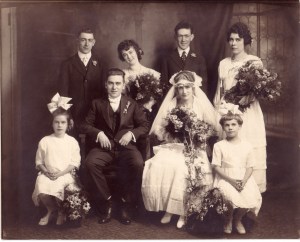
Leonard (Linky) Jensen I (1887-1979) at the wedding of Daisy Jensen (1892-1986) and Francis (Frank) Joseph Woods (1891-1972) in 1918 in Chicago, Cook County, Illinois.

Is marriage like running a business?

“A successful marriage is an edifice that must be rebuilt every day”
Andre Maurois – French author

Today is a very important day for me. It is my 30th wedding anniversary – a time for great celebration and reflection. I am truly blessed having shared the past 30 years with my wonderful wife in a great marriage with all its joys and challenges.

Can lessons can be learned from a great marriage that can be applied to managing a successful business?

Yes, there are many………

Here are just three lessons from a successful marriage that can be applied to business.

Lesson 1: Communication

Continuous two way frank and honest communication is the hallmark of a successful marriage. Problems can be aired, solved constructively and the future discussed. It is the same in business – communication with staff, between departments and with customers provide the mechanics of a successful business. Goals and successes can be shared and problems solved. Communication is about caring and sharing. Customers and staff do not want to be left ‘in the dark’. Two-way continuous communication helps ensure staff and customers feel valued and are committed to you and the organisation. Too often we become complacent and fail to communicate regularly. I can remember some years ago a situation where I increased the rates to a customer without communicating the reasons. They immediately sought competitive proposals and then advised us they wanted to leave. Luckily our Operations Manager was able to remedy the situation by discussing the reasons for the increase only to find that the order and customer profile had changed significantly and the rate schedule was now no longer suitable. Frank two way communication had not occurred, we did not know the profile had changed and we had not advised the reasons for the increase. It was a lesson learned.

Lesson 2: Commitment

Any relationship or partnership is not all smooth sailing, whether it is managing a business or a marriage. For example, challenges are thrown up on the marriage journey that must be faced. Many are outside our control. Reflecting on the past 30 years of our marriage we had to face the challenges along the way. Whether the challenges were family issues or geographic isolation from family and friends, we were committed to making it a success. The same can be said for businesses. If you are committed in managing a business effectively or growing a business you need to meet the challenges as they emerge. Often in business we face crises that could destroy the business. I can remember a situation when a customer owed us over $350,000 and claimed they could not pay. If they failed to pay, our business would probably have been destroyed. Luckily through commitment in enforcing a payment plan we were able to get the money owed and save the business.

Lesson 3: Celebration

Too often we do not celebrate what is important, whether in business or in a marriage. Celebrating our marriage success such as anniversaries or milestones.

Business is no different. Looking back in our business we rarely celebrated successes such as winning a new contract. Later we found out that staff wanted to know our success and suggested we should celebrate with a BBQ or luncheon. However we did recognise staff service and made a big deal about its importance. Our business had staff that had been with us from the beginning and were still there 15 years later. We celebrated this by presenting awards and a gift at our annual management conference.

As the quote from Andre Maurois suggests success in marriage is about continuously rebuilding. The same goes for managing a successful business.

Communication, Commitment and Celebration is a good start. Complacency leads to stagnation and more often than not, failure.

What are your plans to continuing improve your organisation and business?

Business continuity …do you have a plan?

elephant in room - 2

Business continuity …do you have a plan?

What would happen if you did not turn up to work today?

This is a very important question for business owners.

Would your business continue to operate?

Can it continue to grow and can you sell it?

In a recent bog, I wrote about my friend Tim Boyle, Australia’s first kidney lower intestine transplant recipient and his positive attitude in the face of a seemingly impossible situation. This helped him get through a complex and lengthy surgical operation and be out of hospital in five weeks. At the time of writing this blog Tim is recovering well.

As a finance broker, he was passionate about providing people with opportunities to own their own home. Over the long years while he was waiting for a suitable donor, Tim continued to build his business and put in place contingencies for the business to operate without him. Whilst recovering in hospital he talked to staff at all levels explaining how important it is own your own home. I witnessed nurses coming up to him and thanking him for giving them hope. His business continued to operate.

However the real message was that his business continued to operate whilst ‘not being there’. His staff of two continued to work without him being there.

Why?

Because there was a business continuity plan – it could operate without Tim, the owner being present.

This is one of the biggest issues for small to medium sized (SMEs) owners – the elephant in the room. Would your business survive without you coming into work?

If your business cannot operate without you, then your business is vulnerable. This goes to the next step. Should you wish to sell your business in the future, and the business is dependent on you on a daily basis then the value to a potential buyer is significantly lower.

The following link summarises how it is important to be a ‘leader’ rather than a ‘doer’, otherwise your business cannot operate (or grow) without you.

Putting it bluntly, the first step is to put your ego aside and plan to have your business operate without you……………you can go on holidays, be absent, protect your wealth, family relationships and your health.

You have nothing to lose and everything to gain………….

Three things my mother taught me about business…

Mom's_Rule_04

Three things my mother taught me about business…
My mother taught me to appreciate a job well one – “If you’re going to kill each other do it outside – I have just finished cleaning!”
 Anon

In Australia Mother’s Day is in May. This is the day that you should thank your mother and reflect on what a wonderful person she is. Apart from appreciating a job well done what else did your mother teach you?

As a business owner and manager can we learn from our mothers?

My mother was a school teacher, a city girl who married a farmer in rural New South Wales in the 1950s. This was probably not the life her father, a senior public servant had envisaged for his youngest daughter. Perhaps this background helped her in teaching her sons about life.

Here are three things my mother taught me that have helped me in business.

  1. Strong work ethic

My earliest memories of my mother were of her looking after her four sons and making significant sacrifices. Mum went back to work when my youngest brother went to school primarily because her income would help support and educate our family. The uncertainties of rural life with droughts and low commodity prices meant ‘off farm’ income was essential. She would drive off every day to teach, come home do her domestic chores and then plan and mark schoolwork well into the night. This hard work had its own rewards; providing an education for her sons, satisfaction of educating and inspiring the children she taught and providing financial stability for the family. There is no substitute in business for hard work with a clear goal in mind.

  1. Perseverance

Rural life is often hard and at times an unrelenting grind as the lines in the Eric Bogle song “Now I’m Easy” say

“Of droughts and fires and floods I’ve lived through plenty

This country’s dust and mud have seen my tears and blood”

Through the heat, the droughts, low prices, flies and dust Mum persevered supporting Dad, and providing physical, emotional and moral support to the family. Mum would say, ‘Put your back into it and keep going’, and I’ve taken this thinking into business. Even if the worse appears to have occurred, stay calm, focus and carry on. Don’t sweat the small stuff, and don’t get caught up in the crisis. With focus and hard work, it will pass.

  1. Fierce self-reliance

My mother was fiercely hard working, independent and had a strong sense of self belief often introducing new ideas into a conservative rural community. She instilled in all her sons these qualities of independence and self-belief with a strong emphasis on the value of education. When you’re young and starting out in a new job or a new business it can be hard to remember in the face of critics, how important self-reliance is.

So on Mother’s Day think about what your mother taught you when you were growing up and thank her. Mum’s qualities taught us to trust in our decisions and do not hide from our mistakes. As Mum would say:

“It’s not the mistakes you make, but how you deal with them”

implying that a high work ethic, perseverance and fierce self-reliance will see you through.

As a business owner or manager can you use the qualities your mother taught you to improve your business?

Constant renewal – lessons from the farm

Bathurst-Burr-2

Constant renewal – lessons from the farm

I grew up on a farm in north western New South Wales, Australia. In my opinion it was one of the best groundings in life you can have. Many things observed and experienced as a child growing up on the farm can be related to business.

One experience that comes to mind is the problem of weeds.  This can be related to continuing to improve both your management performance and your business.

On our farm, weeds, specifically burrs and thistles were a major problem. In particular there was a burr called a Bathurst burr. Bathurst burr is amongst the most common and economically serious weeds in Australian agriculture. It readily adheres to the wool of sheep. Wool contaminated by Bathurst burrs is a substantial cost to the wool grower as additional processing is required to separate the burrs from the wool. The burr was first introduced to the city of Bathurst, Australia’s first settled inland city in about 1850. It was trapped in the tails of horses imported from Valparaiso in Chile. Perhaps it should have been called Chile burr!

As my father was a woolgrower, Bathurst burr was a major issue.  As children we were often sent out with a hoe to chip Bathurst Burr along the outside of the cultivation paddocks and roadside. Call it character building. However, compared to other properties in the district our farm had relatively small amounts of this burr.

Why was this so?

It was not from our childhood efforts chipping weeds along the roadside!

It was due to my Dad, who was constantly on the lookout for burrs. When horse riding whenever he saw a Bathurst burr, he would dismount from his horse and pull it out. As children we were fascinated by this obsession of eradicating Bathurst burrs and would often point them out to him if he missed one (this was very rare as being an Aussie bushman he had excellent eye sight).

By comparison, my school friend Graham who also lived on a farm had a different experience. I can remember his father’s place having far more burrs than ours. Like my father, his father would often send him out chipping burrs. However, his father became ill, involving hospitalisation and was unable to walk around his farm and keep burrs under control.

What was the difference?

It was because of the constant attention to keeping the burrs under control – often on a daily basis.

And this is the lesson for managers and business owners. Managing is not about platitudes, big schemes and projects. It is about constant attention to detail, continuing seeking ways to improve……… everyday.

As a manager are you keeping the burrs in your organisation under control?

Nothing is easy…

Donald Trump

“Nothing is easy”

Donald J Trump US President

As much as I object to Trump’s mindless self- promotion and gigantic ego, his statement above rings true for those of us who strive to improve our businesses and careers. Unfortunately today with instant electronic communication, we hear stories of “overnight success” that implies it’s easy to be successful. Poor research (may be its no research) light weight and lazy journalism and the perceived need for ‘instant’ gratification or success spread this expectation. Most of these overnight success stories are the result of hard work and sacrifice. Think of JK Rowling the writer of the Harry Potter books who as a single mother on social security benefits, spent years writing, often in an Edinburgh café before her first novel was accepted.

The only example of instant success, apart from winning a massive lottery draw I can think of is the story set in 1960s about Sir Frank Packer, millionaire media owner and father of Kerry Packer. The story goes that Sir Frank, in finding himself in an elevator of his Sydney office building along with a shabbily-dressed man, is outraged. Packer tells the man he’s a disgrace to his firm, fires him, and hands him $1,000 to buy a new suit. The ‘fired’ man just grins — he’s actually a freelance photographer who stopped by to visit a friend who worked in the building. 

Malcolm Gladwell in his book Outliers: The Story of Success introduces the idea practice (or hardwork) which he calls the 10,000 hour rule, makes perfect, and success is not due to the random distribution of genetic gifts or luck. He uses examples of The Beatles and Bill Gates whose success he attributes to the 10,000 hour rule of music and computer practice combined to a much lesser extent with opportunity.

Think of successful people around you, whether in business or in society. Almost always their success is the result of hard work and focus over many years.

I can remember doing post-graduate studies, working a 12 hour day in a demanding job with a 3 children under 5 years old and wondering whether it was worth the sacrifice for my wife and I. It was. It led onto lecturing at university, being head hunted for a job and ultimately into our own successful business.

As Donald Trump said “who wants nothing”…………….

As I tell my children………….the only place where reward comes before work is in the dictionary.


A New Beginning

Tim

A New Beginning

‘To say it is life changing is an understatement — it is a new life, not life changing’

Tim Boyle (Australia’s first kidney and lower intestine transplant recipient)

This is a quote from colleague and friend Tim Boyle, who became Australia’s first kidney and lower intestine transplant recipient in October, 2015.

Twelve years ago Tim received the news that his lower intestine was no longer working and had it removed. Although he could eat, he could only process 10% of his intake as nutrition and had to be fed via an intravenous drip. Less than 2 years ago his kidneys failed which meant each week he spent up to 50 hours attached to medical machines.

You can read his story in the links in the website Daily Mirror and on SBS.

Despite these setbacks, Tim remained optimistic for the future and was committed to his young family and continued to build his business. Although he had time to catch up for coffee, produce a monthly newsletter and write a book we noticed a slow decline in his health and in the last few months this became a rapid decline. Although he acknowledged this decline we ‘outsiders’ noticed a more rapid decline and feared for his future.

Tim’s journey and his quote got me thinking. How does this relate to business?

Many businesses are like Tim’s health. Slow decline not noticed by those in the business, whether it be the owners or employees but noticed by those outside. Complacency and accepting the current situation in business can be fatal. This can catch up on you without realising the true situation and can result in business failure.

It’s now January and the start of a new calendar year and it is time as Tim stated “it is a new life”. In Australia, January is the summer holiday period where staff are either on holidays or tend to be more relaxed. For business owners and managers it is time for reflection on the previous year and to plan for the next. Time for a new beginning…………

So what should you be doing?

What you should not be doing is relaxing and allowing the status quo to continue……it could be fatal to your business.

Here are some 5  suggestions to get you thinking (and acting!)……….

  1. Learn lessons from last year – write down what you have learned, good and bad and act on them for the next year
  2. Set goals for the next 12 months – write them down, be positive and ensure they are realistic and will make you look back in 12 months with a sense of achievement
  3. What bad habits should you eliminate? – we all have bad habits that if we change will make us, our staff and customers more productive, engaged and motivated
  4. Thank your staff and customers – in particular those who helped you and the business in the past year. Hopefully you would have done this before Christmas
  5. Clean up anything left over from the previous year – there is nothing better than starting the new year with a ‘clean slate’. Leftover tasks stop you moving forward with energy and enthusiasm for the new year deserves.

So let January be a period to commence the new year with a positive plan and outlook for the next 12 months, leaving the old year behind…………..

And think of Tim and remember this year is an opportunity for ‘a new life’………..

Post Note:

If you haven’t done so, why not consider becoming an organ donor? It is really easy to do but unfortunately most people don’t only because they haven’t thought about it. In Australia we have long waiting lists due to lack of donors and it truly saves lives. Tim waited 4 years and was unlikely to see Easter. Luckily ground breaking surgery with a different donor blood was successful.

Go to www.donatelife.gov.au for all details.

Christmas…its that time of year again

Xmas

Christmas…its that time of year again

“The thing about Christmas is that it almost doesn’t matter what mood you’re in or what kind of year you’ve had – it’s a fresh start”

Kelly Clarkson – American song writer and philanthropist

As business owners and managers, the Christmas period can be either a period of joy and celebration or a disaster.

Every year we hear stories of work Christmas parties that go wrong…..drunkenness, inappropriate and embarrassing behaviour, work accidents and the like. Often management or the organisation is blamed for the outcomes. It all the more disappointing when it is traditionally a period of cheer and goodwill. In Australia it is also the start of the summer holiday period so generally everybody is in good spirits.

The Christmas party provides a great opportunity to build on the season of goodwill and to say thank you. Any manager who does not take this opportunity has failed as both a leader and a manager.

I can remember a Christmas Party where the staff looked forward to the event, bringing their families including children and grandchildren to enjoy the jumping castle, rides, ice cream and soft drinks. The free raffles were always fun until the business owner’s numbered ticket was picked from the barrel. He promptly walked up and collected his prize. His managers were horrified and embarrassed because it displayed a lack of self-awareness and leadership. They also witnessed the negative reaction from the staff and their families. A better option would have been to say “draw the raffle again” – putting your staff and families first and showing that you are a leader.

Another example was related to me by a friend. At their staff Christmas party, the CEO came down and had her meal, chatted briefly to her general managers before disappearing back to her office. All without thanking staff for their efforts or wishing them all the best for the Festive Season. This was left to her deputy. This total lack of leadership was noted by the staff attending. If you do not show respect to your staff it will not be reciprocated. A quiet and sincere speech of less than a minute would have given quite a different outcome.

So what should you as a manager do for your staff at Christmas?

Celebrations aside, the traditional period of goodwill is an excellent opportunity as a manager to ‘rise to the occasion’ and display leadership. Talk to all your staff and their families. Display graciousness and sincerity about your staff’s efforts. Wish them the best and paint hope and opportunity for the future. It is a time for renewal and evaluation so take advantage of this great opportunity………..

And to all the readers of this post, thank you for reading my posts and I wish you and your families the compliments of the Season and best wishes for the New Year.