Gritty leadership from 75 years ago…

“I am ready to try an airlift. I can’t guarantee it will work. I am sure that even at its best, people are going to be cold and people are going to be hungry. And if the people of Berlin won’t stand that, it will fail. And I don’t want to go into this unless I have your assurance that the people will be heavily in approval.”

Lucius D. Clay, June 1948

Military Governor of the United States Zone, Germany (1947 to 1949)

The Berlin Airlift. 75 years ago this month the Berlin Airlift ‘officially’ finished.

What was it?

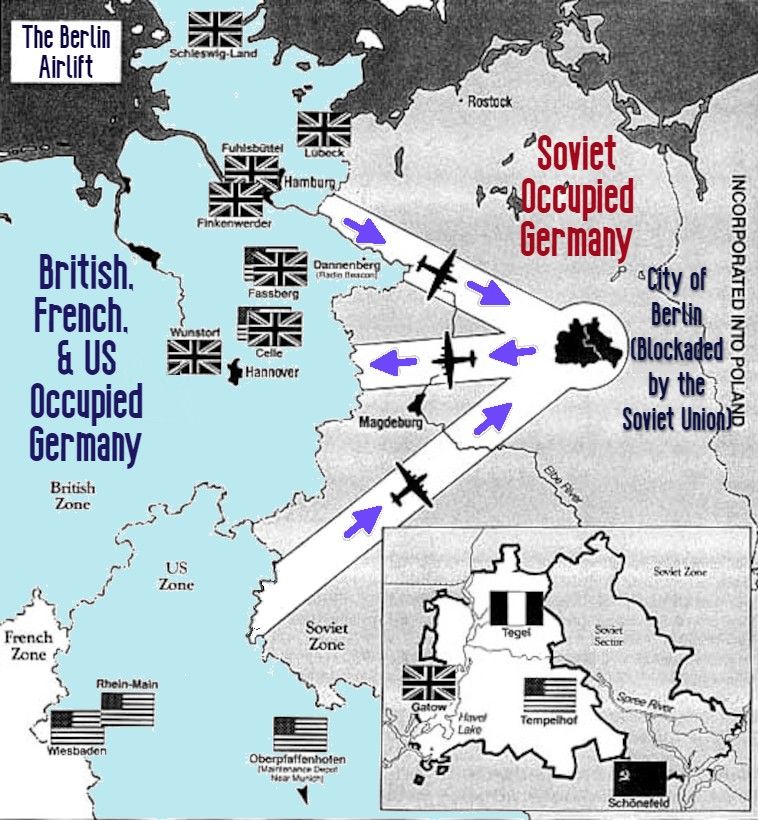
After World War II, Germany was divided into four zones, Soviet Russia, Britain, France and the USA. Berlin was also divided into four zones but lay within the Soviet Russian zone. On 24 June 1948, Soviet forces blockaded all road, rail and water routes into Berlin’s Allied-controlled areas. This stifled the vital flow of food, coal and other supplies. More than 2 million Berliners were relying on the aid, which included much-needed food, fuel and medicine and would otherwise starve and freeze. Two thirds of what was needed was coal.

However, the Russians could not block the Allied airspace. On 24 June 1948. The Allies established an airbridge and began an airlift that lasted officially until 12 May 1949 when the Soviet Union lifted the blockade. The airlift continued until September after the lifting of the blockade as the Allies wanted to make sure that it was not reintroduced.

Why did it occur?

The blockade was an attempt by Soviet Russia to gain control over the entire city by cutting off all land and water routes to West Berlin, which was then under the control of the Western Allies.

Logistics of the Berlin Airlift

The success of the airlift depended on meticulous planning and execution. The planes were scheduled to land and take off at precise intervals, ensuring a continuous flow of supplies. This required exceptional coordination among pilots, ground crews, and logistics teams. To maximise efficiency, the cargo planes followed specific flight paths and adhered to strict timetables. This was all before the use of computers, GPS tracking and scheduling which we have today.

The airlift involved transporting a wide range of supplies, including food, coal, medicine, and machinery. Each type of cargo required different handling and storage conditions, which added complexity to the logistics operation.

Berlin Airlift – Facts & Figures

  • One aircraft landing per minute
  • Over 200 million miles flown
  • Each aircraft unloaded in 20-30 minutes
  • 2000 tonnes of food required per day
  • 400,000 tonnes of food, supplies and coal
  • Over 200,000 kms flown
  • 277,804 flights completed
  • 93 lives lost

The airlift cost the United States $350 million; the UK £17 million and Western Germany 150 million Deutschmarks.

What are three lessons for business leaders in the example of the Berlin Airlift?

  1. Innovative Problem-Solving: Leaders had to think creatively and act decisively to overcome the blockade. This required innovative strategies, such as the airlift, which had never been attempted on such a scale.
  2. Resilience and Determination: Leaders demonstrated resilience and determination in the face of adversity. The operation continued for over a year, and the leaders remained committed to their mission despite the challenges.
  3. Precision and Coordination: The operation demonstrated the critical role of precision and coordination in logistics. Timely delivery and efficient turnaround were essential for the success of the airlift.

In conclusion, the Berlin Airlift was not only a remarkable logistical achievement but also a powerful example of international cooperation, innovative problem-solving, and leadership under pressure. It provided invaluable lessons in both logistics management and leadership that are still relevant today.

What do you think?

Note: 39 British, 31 American and 13 German civilians lost their lives in the Berlin Airlift. They are remembered on the Berlin Airlift monument at Tempelhof. The pilots came from the USA, Britain and France and also from Australia, Canada, South Africa and New Zealand.

@thenetworkofconsultingprofessionals

The Valley of Tears…

“On 6 October 1973, the Yom Kippur war broke out between a coalition of Arab states and Israel. At 6 A.M. that morning, Kissinger, asleep in the Waldorf, was taken by surprise by the Arab attack – as were the CIA and the rest of the world”.

Alistair Horne – British Historian

Fifty years ago next month, on 6th October 1973 the combined forces of Egypt and Syria attacked Israel, the Sinai in the west and the Golan Heights in the northeast. This became known as the Yom Kippur War. The surprise attack occurred on the Jewish Yom Kippur holiday when most of the Israeli military were on leave.

Egypt’s prime reason for the attack was to force Israel to negotiate a peace treaty for the return of the Sinai. The Egyptians did not advance any further than a narrow strip of the Sinai that could be protected by SAM missile batteries. However, the Syrians had different aims, to retake the Golan Heights taken in 1967 Six Day War and destroy Israel. With the unexpected success of the Six Day War, Israel was arrogant, complacent, overconfident, and believed that their intelligence would anticipate any assault.

In particular, the battle of the Golan Heights has some important lessons for managers and leaders.

More than 1,400 Syrians tanks, 28,000 troops and 600 artillery pieces poured into the Golan Heights, opposed by just 180 Israeli tanks, 3,000 troops and 60 artillery pieces. Syrian intelligence had estimated that due to the Yom Kippur holiday it would take 20 hours for the Israeli reservists to reinforce the Golan Heights, however instead it took 10 hours.

By 5pm on 7th October with the Israelis under sustained pressure, the Syrians at the instruction of their President, unexpectedly halted their advance on the road to Galilee. The bridges over the Jordan River were virtually undefended and the road to Israel was open to the invading force.

Despite the overwhelming numbers, the Israeli forces manage to hold the advance in time for the reservists to arrive. In what became known as the ‘valley of tears’, the Syrian armoured forces suffered horrendous losses against a far numerically inferior foe, turning the tide of the battle for the Golan Heights.

So, what happened?

The Syrians were numerically superior, armed with up-to-date Soviet weaponry and night vision equipment which the Israelis did not have. When their lead tanks were destroyed, the Syrian tanks refused to stop, move off the roads or bypass the destroyed vehicles. This caused roadblocks and made them easy targets for the highly trained Israeli tank crews.

The Syrians refused to manoeuvre unless ordered by higher command. Syrian forces demonstrated a critical lack of adaptability and comprehensive training. This was in direct comparison to the Israeli forces, who despite being outgunned and outnumbered, changed their tactics.

The most famous of the adaptability of tactics was a young Lieutenant Zvi Gringold, known affectionately as ‘Lieutenant Zvicka,’. He became a legend and was awarded Israel’s highest decoration. His hit-and-run tactics initially destroyed 10 Syrian tanks and he was credited with single-handedly holding at bay 50 Syrian tanks. The Syrians thought they were up against a large Israeli force and withdrew. Throughout the night and following day, Gringold continued to engage the Syrians and destroyed another 30 tanks. These tactics were copied by other Israeli tank commanders.

The tide in the battle for the Golan Heights began to turn as arriving Israeli reserve forces were able to contain the Syrian advance.  The arrival of the reservists was the beginning of the end for Syria. After four days the Israelis succeeded in pushing the Syrians out of the Golan Heights and began their march towards the Syrian capital, Damascus.

What are the lessons for leaders here?

Lesson 1: Remote and authoritarian leadership often fails. The Syrian advance was unexpectedly halted by the Syrian Dictator President Assad, but the road into Israel was virtually undefended. Clearly the best decisions are often made close to the battlefield and in business close to ‘the coal face’ as the managers have a better understanding of the situation.

How often do decrees from head office seem remote and unrealistic?

Lesson 2: Decentralised leadership is far more effective and allows managers to react to the situation. In this case,case, as demonstrated by ‘Lieutenant Ziva’ the Israelis adapted their tactics to meet the situation, despite the overwhelming numerical superiority of the Syrians.

In our former logistics business, we gave our supervisors the authority to manage customers face-to-face on a daily basis, without always referring to the Warehouse Manager. This enabled them to manage the usual crises that occur in logistics in a proactive and ‘customer centric’ way, resulting in customers staying with the business over the long term.

Lesson 3: Over confidence and arrogance are dangerous. With the overwhelming success of the 1967 Six Day War, the Israelis were arrogant. They ignored the intelligence and were caught short. As Andy Gove, the founder and former CEO of Intel said; “only the paranoid survive”. Gove warned against the ‘inertia of success’.

Can you think of any businesses that were initially successful but failed because they were complacent and arrogant?

Kodak dominated the photographic film industry with over 50% of the global market share. It ignored the market disruption caused by digital cameras. Ironically, a Kodak engineer in 1975 invented the digital camera, but it was ignored by management. In 2012, Kodak filed for bankruptcy.

#thenetworkofconsultingprofessionals
Management lessons from a long-forgotten battle…

“Arrogance, ignorance, and incompetence. Not a pretty cocktail of personality traits in the best of situations”

Graydon Carter – US Journalist

70 years ago this month, the colonies of French Indochina were lost when the Communist Viet Minh guerilla army defeated French forces in Vietnam in the Battle of Điện Biên Phủ.

Background

Following the Japanese surrender in World War II, the Viet Minh, a Vietnamese Communist guerilla army declared independence from France. France did not recognise the new government, and the first Indochina War began when the French navy bombarded the port city of Haiphong in northern Vietnam in November 1946, killing thousands of Vietnamese civilians. The war continued for another seven years and by 1953 it was at a stalemate. It had not been going well for the French. The war was unpopular, costly, and the French political environment was unstable. During the seven years of war, there were 16 changes of government in France and 13 changes of prime minister. Clearly, domestic political instability helped undermine the war effort.  

Setting

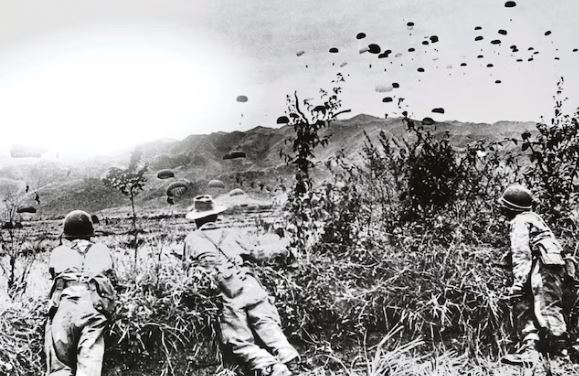
A French needed a solution to break the stalemate, so negotiations could be conducted. The French plan was to create a military situation which would bring the Viet Minh to the negotiating table. In late 1953, 2,000 French paratroopers were dropped deep in Viet Minh held territory in north-western Vietnam at a town called Điện Biên Phủ to establish a heavily fortified base.

The aim was to cut the Viet Minh supply lines from Laos and provide a base from which to attack them in the countryside. The French strategy was to draw out the Vietnamese and destroy them with superior firepower. They believed they held all the military advantages – the military equipment, the planes, trained soldiers, and the artillery. This strategy was called the hérisson (‘hedgehog’) concept. It was based on the success of the 1952 Battle of Nà Sản, where a fortified French camp supplied only by air repeatedly beat back the Viet Minh who suffered heavy losses. By repeating this strategy at Điện Biên Phủ on a much larger scale, using superior artillery and air support, the French believed they could defeat the Viet Minh in set piece battle. But the Viet Minh were fighting a guerilla war.

Outcome

In March 1954, the battle of Điện Biên Phủ began with a massive artillery bombardment by the Viet Minh. They were strategically positioned in caves and dugouts in the hills above the base. This lasted until May when 16,000 troops French were soundly defeated.

With over 50,000 Viet Minh troops surrounding the base, roads to supply the French garrison were cut which necessitated being supplied by air. The French believed that the Viet Minh had no anti-aircraft capacity and limited artillery. This proved to be incorrect, and the planes were forced to fly higher and higher, which resulted in supplies often falling into the Viet Minh’s hands.

The Viet Minh leader, General Giáp had learnt from the losses at Nà Sản. He spent months planning the transporting and stockpiling ammunition, and placing heavy artillery and anti-aircraft guns in tunnels in the hills around the French base. Furthermore, thousands of local peasants who supported the Viet Minh, including many women, provided labour, built roads, cleared jungle, transported food by foot and on bicycles and hauled equipment. Over 300,000 people were involved in the Viet Minh logistical effort.

With tenacious fighting on the ground resulting in horrendous causalities, the Viet Minh dug trenches and gradually encroached on the French base, finally cutting the runway. This forced the French to deliver supplies and reinforcements by parachute. As key positions were overrun, the perimeter contracted. While at times, the French repulsed Viet Minh assaults, airpower and superior military equipment did not win the day. The siege ended with a humiliating defeat for the French with 2,293 killed. The Viet Minh suffered horrendous casualties with over 8,000 Viet Minh fighters killed and an estimated 15,000 wounded.

Are there management lessons from the Battle of Điện Biên Phủ for managers today?

Here are three to consider:

1. Do your homework and understand your competitorsknow your enemy

The French underestimated their enemy. The French did not know the number of Viet Minh troops or how many artillery pieces they possessed and, furthermore the French believed that the Viet Minh had no anti-aircraft capability. Not only did they misjudge their enemy, but the French also discounted the huge material support received from the Communist Bloc, in the form of left-over stockpiles of Soviet-made and captured American heavy artillery and anti-aircraft artillery from the Korean War. By comparison, Giáp knew the strength and weaknesses of the French from his spies in the camp, and from the hills overlooking the French base. Unlike the battle of Nà Sản, the Viet Minh controlled the high ground, a major strategic oversight by the French. Clearly, the French did not do their homework, were arrogant and had no Plan B.

2. Technological superiority does not guarantee success

The French strategy was to defeat the Viet Minh in a set piece battle using their superior military technologies and resources – artillery, aircraft, trucks and tanks. Artillery and tanks had been dismantled and delivered by air and then reassembled on the ground. This strategy did not suit a guerrilla war, where having the support of the general population is critical. The Viet Minh’s supply chain did not rely on the use of modern technologies such as aircraft, but instead thousands of peasants carried food, ammunition and the dismantled artillery pieces into hidden and protected positions in the hills above the base. It was a triumph of logistical planning.  

Technology can make you vulnerable. The Viet Minh’s artillery closed the airstrip halfway through the siege, necessitating parachute resupply. The efficient anti-aircraft artillery forced the planes higher, and a high proportion of the supplies fell into the Viet Minh’s hands, including ironically the French Commander’s new general’s stars dropped with a bottle of champagne.

My experience in niche logistics business was when our biggest competitor decided to invest millions of dollars in state-of-the-art equipment and take out a long-term lease on an expensive warehouse. Their major customer, a major retailer was slow to use their services, and they eventually ran out of money and were bankrupted.

3. Be prepared to change your plan when conditions or the situation changes

Giáp’s initial strategy was based on the Communist Chinese “Fast Strike, Fast Victory” model. The aim was to attack the French garrison command centre with overwhelming force to a secure victory. However, the Viet Minh found out that the French knew about this plan, and their technological superiority combined with well dug in troops would have made this strategy fail. Instead, Giáp changed to a siege strategy. This helped ensure success. By mid-1953, the First Indochina War was in its seventh year and for either side there was no obvious prospect of victory. The French had tried a variety of tactics to defeat the Viet Minh, which failed. Exhausted and devoid of ideas, they had no long-term vision or overall strategy, which was in stark contrast to the Viet Minh. They simply defended their positions and reacted to attacks when they occurred.

A road transport client of mine, experienced a drop in revenue by 75%. However, he became far more profitable by changing their strategy, ditching difficult and unprofitable customers.

Do you think there are any other lessons for managers?

#thenetworkofconsultingprofessionals

It’s that time of the year again..

“Christmas is a season not only of rejoicing but of reflection”
Winston Churchill

In December 1843, Charles Dickens published his book A Christmas Carol. The book was set against significant changes in British society. As Britain industrialised there was a mass movement of people from the countryside to the cities. Dickens witnessed this change and the resulting appalling conditions of child labour.

The book’s messages are timeless. Radical for the time, one significant theme from the book is that employers were responsible for the wellbeing of their workers,

Firstly, lets briefly recount the story.

The book is about a mean-spirited and selfish old man called Ebenezer Scrooge who hates Christmas.

“Bah Humbug” he says.

Scrooge is unkind to the people who work for him. He does not accept an invitation from his nephew to spend Christmas with his nephew’s family. He also refuses to give to any charity. On Christmas Eve he is visited by the ghost of his former business partner Jacob Marley, who warns him that three ghosts will visit him that night.

The first ghost is the Ghost of Christmas Past. He takes Scrooge to his past as an unhappy child and to a man who forsakes his fiancée for the love of money. The second ghost is the Ghost of Christmas Present who takes him to the family of his clerk, Bob Cratchit. At the house Scrooge sees Cratchit’s ill son Tiny Tim. Then the ghost takes Scrooge to see his nephew’s Christmas celebrations he had refused to attend. The final ghost, the Ghost of Christmas Yet to Come shows Scrooge his own death and how he will be remembered. This terrifies him as there is no-one to mourn him.

The ghosts’ journey through time makes Scrooge see the error of his ways. On Christmas morning, Scrooge wakes up and is transformed into a kinder, gentler man. He buys the biggest turkey for the Cratchit family and then spends Christmas Day the day with his nephew and family.

What are the messages for employers and managers in A Christmas Carol?

With Christmas being at the end of the calendar year, it is an excellent time for managers to reflect, consider the past, in particular the past year, the present, and the future, just like the three ghosts.

As a manager and business owner what are you going to do about Christmas for your staff and customers?

It’s the season of goodwill – don’t waste the opportunity!

#thenetworkofconsultingprofessionals

The Great Emu War

“The incompetent leading the unwilling to do the unnecessary.”
Evan Wright – American author

Military failure is everywhere. As managers and leaders, we can learn from classic instances of so-called military incompetence. There are many examples from the disastrous Allied landing at Gallipoli in World War I, to operation Barbarossa, the failed Nazi invasion of Soviet Union in World War II and to the 1954 Battle of Dien Bien Phu in French Indochina which resulted in catastrophic defeat for the French.

However, few examples could be more humorous, without loss of human life and just as instructive for managers on ‘what not to do’ as the Great Emu War of 1932.

What are the characteristics of an emu?

They are an enormous bird second in size to the African ostrich. They cannot fly and have an average height of over 2 metres, very strong legs, can run up to 50 kph, and naturally flock in large numbers.

Background to ‘the conflict’

Following the end of World War I, the Australian government ‘rewarded’ returning soldiers with farm land. In Western Australia the veterans or ‘soldier settlers’ were allocated farmland which was very marginal for the growing wheat. Very few were experienced in agriculture. To add to the farmers’ challenges a severe drought hit, and 20,000 starving emus came in from the desert and commenced in destroying the existing wheat crop. Furthermore, this occurred in the Great Depression with a background of rising unemployment and falling wheat prices

The veterans lobbied their local parliamentary representatives to provide assist to rid the country of the emu ‘menace’. A Western Australian Senator, Sir George Pearce, recommended that the veterans and troops should tackle the problem head-on and hunt the birds. The government needed to show support for the famers. As the saying goes, “never waste a good crisis”.

What better opportunity for politicians than to provide a well-publicised effort to protect the former veterans who were ‘doing it tough’ and call in the army?

So certain that the operation would be a success, a cinematographer was hired from Fox Movietone to cover the hunt.

On the first day of ‘war’ less than 50 birds were killed out of the thousands shot at. The biggest misconception about the Emu War is that it was a massive assault staged by the Australian military. It was just three soldiers, a small truck, two Lewis machine guns, and 10,000 rounds of ammunition. A machine gun was mounted on the truck, but the truck could only travel a 30 kph over rough land, no match for an emu who could run at 50 kph and the truck could only chase one emu at a time. Furthermore, the soldiers couldn’t stabilise a machine gun on the vehicle or shoot with any accuracy.

The Great Emu war lasted less than six weeks – 986 emus were killed, and 9,860 rounds of ammunition was expended. Ten rounds per dead emu – not a great kill ratio although the only loss for the soldiers was their pride!

A more effective plan was later introduced. Rather than use brute-force the government set aside money for bounties. The farmers did the hard work of tracking and shooting the emu menace. Two years later in 1934, nearly 58,000 bounties were claimed.

What lessons are there for us as managers in the ‘great emu war’?

Here are three worth considering.

  1. Be aware that politicians do not have the answers for problems of business. Many, in particular politicians today have no business or managerial experience. Governments overpromise and under deliver. The management of the COVID pandemic is a good example.  
  2. Technology is not the answer. Technology is an enabler and not the magic bullet to solve the problem. Having a motor vehicle and machine guns did not solve the problem as it was not clearly defined.
  3. The most successful solutions involve the parties directly involved in the problem. By offering bounties, the farmers had a direct incentive to make it work – and they made money out of the bounties and reduced the number of emus attacking their crops.

#thenetworkofconsultingprofessionals

So where is Werris Creek?

“Many times, the wrong train took me to the right place.”

Paulo Coelho – Brazilian lyricist and novelist

Whist undertaking post graduate studies many years ago, one of my fellow students and friend was a senior executive of Queensland Rail. He had started his career as a clerk in a rural railway station in outback Queensland and went on to hold senior executive positions in rail businesses in Australia. Clearly rail was in his blood, as his father had been a fettler on the railways.

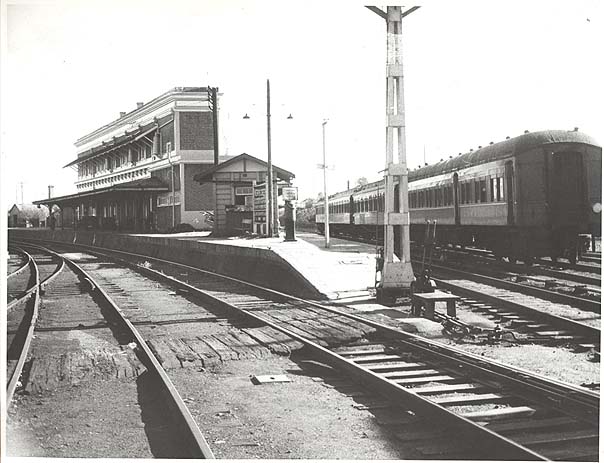
One of his father’s postings was to the tiny and declining town of Wallangarra on the Queensland New South Wales border. The town had been established in 1885 for the sole purpose of being the connecting link between the NSW rail system and the rural Queensland rail system. Wallangarra was the result of two state governments deciding to build railways of different gauges; narrow gauge in Queensland (1067 mm) and standard gauge in NSW (1435 mm). This meant that people travelling from Queensland to NSW had to alight at Wallangarra and change trains in the historic town of Tenterfield just across the border. Not surprisingly this ensured that the tiny settlement became a major railway junction.

In northwest NSW, there lies another important railway junction town called Werris Creek. Werris Creek like Wallangra did not exist until the late 1870s when the railway arrived. A town of approximately 2,000 people, this was where trains from Sydney could be diverted onto three branch lines to various locations in country NSW, with one branch line terminating in Tenterfield. By co-incidence, as a young farm boy I lived less than 20 minutes’ drive from Werris Creek.

Anyway, back to my friend and fellow student. During the school holidays, he worked as a casual railway porter moving luggage from Wallangarra to Tenterfield, just across the border. All the luggage was marked ‘To Werris Creek’. As a young, and obviously naïve lad, he thought that Werris Creek was one of the largest cities in NSW. Having lived near Werris Creek the irony of this was not lost on me.

What are the lessons here?

How often are we as managers given a picture of a situation that is unrealistic?

Today, in the age of the internet there are organisations that appear much larger and more substantial than they are in the real world. With the advent of social media, virtual organisations and people exist.

Doing your homework will certainly help and don’t take things on face value.

This what I call this the ‘Werris Creek Affect’

Can you think of examples of ‘Werris Creek Affect’ in your working life?

Post note: the last train left Tenterfield in 1988 and the last scheduled train to Wallangarra left in 1997.

#thenetworkconsultingprofessionals

The Atlantic Conveyor Affect…

“It’s OK to have your eggs in one basket as long as you control what happens to that basket”
Elon Musk – billionaire businessman

Just over 40 years ago on 2nd April 1982, Argentina invaded the British overseas territory of the Falkland Islands. They are an island archipelago in the South Atlantic Ocean located over 12,000 kilometres away from the British Isles. The Falklands were a community of just 1,800 people, primarily rural sheep farmers, the majority of whom were of British descent.

In the face of this challenge, the British government under the leadership of Margaret Thatcher organised a Task Force of over 100 ships, including naval vessels, merchant ships, and a submarine all carrying supplies, military equipment and troops. An extraordinary feat considering the tight time frame and the huge distances involved.  

At the time Argentina was ruled by a brutal military dictatorship. Argentina had claimed sovereignty over the islands for many years and the ruling military junta did not believe that Britain would attempt to regain the islands by force. With falling popularity and failing economy, the junta saw the invasion as a diversion from their domestic problems.

On 21st May 1982 British forces landed on the islands. On 25th May the container ship, Atlantic Conveyor, a ship requisitioned by the Royal Navy was hit by two Exocet missiles fired by the Argentinian air force, killing 12 of the crew including captain. Due to the presence of both fuel and ammunition that were stored below decks, the incendiary effect of the unburnt propellant from the missiles caused an uncontrollable fire and the vessel sank three days later.

What else was lost?

Apart from fuel and ammunition the Atlantic Conveyor was carrying seven Westland helicopters, four Boeing Chinooks, and a Westland Lynx. Only one Chinook one Westland Wessex were saved. Almost all the Task Force helicopters were on this ship.

Did this influence the plan to retake the islands by the British forces?

Yes, the plan to ferry troops by helicopter could not be carried out, resulting in a significant change of strategy. The loss of these helicopters meant that British troops with the onset of winter had to march on foot across the wet and semi-frozen ground to recapture the island’s capital, Stanley. However, despite this setback, Stanley was captured on 14 June 1982 – the war having lasted only 74 days.

So, what do you think is the main management lesson from the sinking of the Atlantic Conveyor?

Do not put all your eggs in one basket. Having most of the helicopters on one ship making it vulnerable to a missile attack was a very poor decision!

Can you think of other management lessons from the sinking of Atlantic Conveyor?

#thenetworkofconsultingprofessionals
Rabbits, dams and engineering faults!

“He who chases two rabbits, catches none”
— Confucius

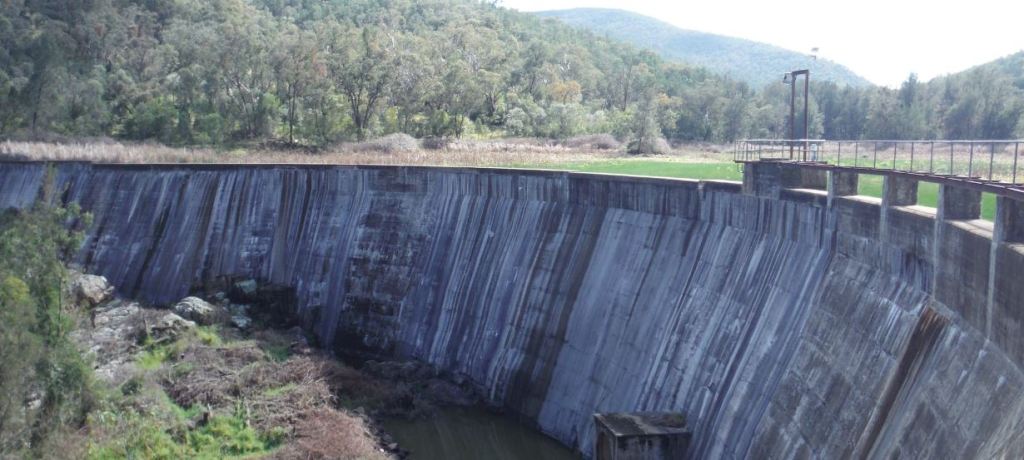
I grew up on a farm in northern NSW. Running through the property was a creek which had two significant dams on it. The first dam was called ‘the old Quipolly Dam’. This concrete span dam wall was built in the early 1930s to provide water for the town of Werris Creek, a town that did not exist until the coming of the railway in the mid-1870s. Being a major rail junction town, water was essential as steam engine locomotives require lots of water. The second newer dam bordered our property. It had an earth wall and was built in the late 1950s to replace ‘the old Quipolly Dam’.

By 1947, when my father moved onto our farm with his parents ‘the old Quipolly Dam’ had silted up. This was less than 15 years after it had been constructed. My father told me that during the 1940s drought rabbits had denuded the landscape. Without grass ground cover, heavy rain caused severe erosion. The sediment ended up in ‘the old Quipolly dam’ as silt. This seemed a logical explanation for the silting.

My father spent his whole life trying to eradicate rabbits on the farm. Trapping, poisoning, releasing calicivirus and myxomatosis viruses, ripping rabbit warrens and shooting them. As young boy I trapped and shot rabbits and every year we undertook a poisoning campaign.

So, the rabbits seemed to be a logical explanation.

Several years later I was doing some family history research and found an engineering research paper. It studied several small railway dams built between 1890 and 1932 in NSW that had silted up. One of dams studied was ‘the old Quipolly dam’. The research paper concluded that ‘the most extreme hydrological events are extreme floods following a long drought period’ and this led to where ‘large sediment loads are carried away into the reservoirs.’

So, were ‘the rabbits’ were responsible for the dams’ siltation problems?

Well, not exactly.

Whilst erosion was a contributing factor, the main reason was a design flaw in the dam’s walls. The basic design of the dam’s arch wall had not changed in over 40 years. This was despite the fact that several dams with curved concrete walls had silted up within 25 years, all before the construction of ‘the old Quipolly Dam’. The wall design did not consider the fundamental concepts of sediment transport. The dams did not have a large outlet for sediment ‘flushing’, resulting in a silt or sediment building up against the curved dam wall.

Rabbits and probably overgrazing that had denuded the landscape during a drought were not the underlying cause of the silting up of the dam, but a contributing factor only.

What do you think the management lesson is here?

Here are some to consider.

We can all remember being told something in our working lives and then finding out this was incorrect. Remember the ‘weapons of mass destruction’ that Iraq had that were used as a pretext for invasion?

Perhaps another lesson is not to believe what bureaucracies or governments do or tell you. In this example, there were several dams of similar design that silted up well before ‘the old Quipolly Dam’ was built.

  • Often, an explanation that seems logical may not be the cause of the problem. In this example, it was only a contributing factor.

As a logistics professional I am continually frustrated when allegedly logical transport solutions do not stand up to scrutiny. For example, a common theme pushed by politicians and special interest groups is that the construction of freeways increases pollution.

Really?

Think about it.

If we did not have freeways, cars, average speed would be lower, more stops and starts, traffic lights, slower travel times and more congestion and pollution.

Can you think of other examples in your working life where this has been the case?

#thenetworkofconsultingprofessionals

What is the difference between strategy and tactics?

What is the difference between strategy and tactics?

‘Strategy without tactics is the slowest route to victory. Tactics without strategy is the noise before defeat.’

Sun Tzu

In business we often confuse tactics with strategy. The media refer to some business’ actions as strategies when in fact they are in reality; tactics. For example, with the recent COVID outbreak in Australia, the media referred to hotel quarantine and border closures as strategies when in fact they were tactics in the strategy to stop the spread of the virus.

A tactic is an action or event to achieve a desired outcome.

A strategy is an integrated plan which helps an organisation achieve its objectives.

Tactics are usually designed by middle-level management, whereas top-level management create and implement strategy.

For example, if the strategy of a business is to increase profitable market share (a top-level management action), a tactic could be to increase prices or reduce discounts combined with a marketing campaign (middle level management actions). Tactics often change with the changes in market or economic conditions (the present), whilst strategy remains same for a long period (the future).

If the strategy is wrong, the best tactics in the world will not ensure the strategy is successful. Military conflicts are often good examples where despite sound tactics, a strategy that is wrong will never be achieved. In the Vietnam War, first the French and then the Americans failed due to poor strategy.

A better example is the nasty civil war called ‘the Bush War’ in Rhodesia (now Zimbabwe) from the early 1970s to 1979. In June 1977, Time Magazine reported that “man for man, the Rhodesian army ranks among the world’s finest fighting units“. The Rhodesian military developed a tactic called ‘Fireforce’.

It was a counter-insurgency military tactic using helicopter-borne and parachute infantry to envelop guerillas in the bush before they could flee. The operational assault usually comprised of a first wave of 32 soldiers carried to the scene by three helicopters and a Dakota aircraft, with a command helicopter and a light attack Lynx aircraft in support.  One of the advantages was its flexibility. When contact was made, typically with 6 to 12 insurgents, the 32 soldiers of the Rhodesian Army had immediate superiority on the ground. The tactic quickly yielded an 80–1 kill rate by trapping the guerillas and eliminating them by air and ground fire. However, despite its success measured by the kill ratio, it was not enough to keep the Rhodesians from losing the war, or realising that the war could not be won. KPIs need to measure progress towards an organization, or in this case a government’s strategic goals. Clearly kill ratios, which were also used by the Americans in the Vietnam War were not the right KPIs to meet the strategic goals.

What the Rhodesian Government failed to understand that the ‘bush war’ was political in nature. It was a war for the support of the Rhodesian Africans, not the minority white population. The right-wing government was ill equipped politically to win over the Rhodesian Africans to their side. The government’s budget and efforts were directed to the military side of the war and not the political one. The strategy of stopping majority rule was flawed, politically, morally and geopolitically. Having the best counter insurgency military in the world could not prevent black majority rule.

Also, a minority led white government, not recognised by many countries surrounded by hostile African nation states was never going to prevent guerilla insurgents from entering the country. Furthermore, in the later stages of the war the apartheid government in South Africa withdrew support further isolating the Rhodesian government. There was no plan B until the last year of the war and by then it was too late.

In conclusion, strategy is about choosing the best plan for accomplishing long-term goals of an organisation. Clearly kill ratios, which were also used by the Americans in the Vietnam War were not the right KPIs to meet the strategic goals. Tactics are normally the instant reaction of the organisation, in response to the changing environment whether political or business.

Can you think of examples of where tactics would successful, but the overall strategy failed?

The accompanying table below is a good reference for identifying what is a tactic and what is a strategy.

Basis for ComparisonTacticsStrategy
MeaningA carefully planned action made to achieve a specific objective is Tactics.A long-range blueprint of an organization’s expected image and destination is known as Strategy.
ConceptDetermining how the strategy be executed.An organized set of activities that can lead the company to differentiation.
What is it?ActionAction plan
NaturePreventativeCompetitive
Focus onTaskPurpose
Formulated atMiddle levelTop level
Risk involvedLowHigh
ApproachReactiveProactive
FlexibilityHighNormally less flexible
OrientationPresent circumstancesThe future

#thenetworkofconsultingprofessionals

The Charge……the lessons

The Charge……the lessons

“ With bayonets drawn, they charged the town, they were a fearsome sight

But they had fulfilled their orders, they took the town by night”

From the poem “The Wells of Beersheba” by Warren Eggleton

105 years ago during World War I, British, Australian, New Zealand, French and Empire troops stormed ashore at Gallipoli in western Turkey on 25th April. The plan was to seize control of the strategic Dardanelles Strait and open the way for their naval forces to attack Constantinople, the capital of Turkey and the Ottoman Empire. The campaign failed. The Turks never succeeded in driving the Allied troops back into the sea, and the Allies never broke out of their beachhead. After eight months of bitter fighting the peninsula was evacuated in December 1915.

On 25th April, each year ANZAC Day (the acronym ANZAC stands for Australian and New Zealand Army Corps) is commemorated in Australia and New Zealand with marches and ceremonies, even though the Allies were defeated. This year due to the COVID-19 pandemic, ANZAC Day will not be publicly celebrated, for the first time since 1916.

Ironically Australia’s first great World War I victory, the Charge of Beersheba that ended the Battle of Beersheba is barely remembered or celebrated. It is considered history’s last great cavalry charge and provides some great lessons for managers.

Beersheba (now Be’er Sheva, in modern-day Israel) is situated in desert terrain and was a strategically important town. Here the Allied advance into Palestine was blocked as it was protected by over 4,000 well-armed Ottoman Empire troops in trenches. Beersheba an important transport hub had water wells that were vital in the desert for both men and horses.

The battle for Beersheba began at dawn on 31st October 1917 when the British infantry began attacking with artillery and air support combined with infantry attacks. By mid-afternoon the British had failed to capture the town. The situation had become serious – horses and men needed water. In the late afternoon, looking at a potential defeat the order was given to the Australian Light Horse to charge the Turkish trenches protecting the town.  800 mounted Light Horsemen, armed with bayonets not cavalry sabres, charged over 6 kilometres of open ground towards Beersheba. Initially the Turks opened fire with shrapnel. This was ineffective against the widely spaced horsemen. They then used machine guns. which were quickly silenced by British artillery. The charge caught the Turkish defenders off guard. They failed to allow for the speed of the charge and had little time to recalibrate their weapons for close range fighting.  The Light Horsemen, whose horses could apparently smell the water, jumped over the trenches. Some men dismounted and attacked the enemy with rifle and bayonet from the rear. Others galloped ahead and captured the town and its vital water wells.

If the Allies had failed, over 60,000 troops would have been stranded in the desert without water. If they didn’t prevail, men and their horses who had already been without water for two days faced dying of thirst. It was also the first major victory for the British army over the Turks in World War I. More importantly, the Battle of Beersheba was a precursor to capturing the city of Gaza. The city barred the way north to the important cities of Jerusalem and Damascus. Within a week Gaza fell, and the Allies marched north routing the Turkish troops. The campaign to secure the Sinai Peninsula ensured the Suez Canal remained open to Britain and its allies and led to the collapse of the 400 year old Otterman Empire.

So, what are the lessons for managers from the Charge of Beersheba?

Here are three lessons, that as managers we can learn from the Charge of Beersheba.

  1. 1. A leader needs to be flexible. The Australian commander, General Chauvel had planned to make a dismounted attack on Beersheba but as evening approached, ran out of time. The alternative was to make a cavalry charge. The traditional strategy was to dismount and attack with rifles from a distance. In the open desert this would have made the Light Horsemen vulnerable to shrapnel and machinegun fire. Clearly a different approach was required so a new strategy was devised. The Light Horse attacked like a cavalry unit, with bayonets in their hands like sabres, thereby catching the Turks by surprise. Their speed and determination outweighed their limitations of protection and weapons.
  2. Planning. There is no substitute for sound planning. Fighting a war in a desert required careful planning as Beersheba was surrounded by desert. This posed obvious logistics challenges for moving troops and equipment, particularly mounted troops. British army engineers established forward supply dumps of water and reopened wells that had been blocked by the Turks. This secured sufficient water for the troops and horses as they moved across the desert. Although the town was protected by a system of trenches, there was no barbed wire on one side because the Turks believed they would not be attacked through the desert from the southeast. The British-led forces, by careful planning and doing their homework  proved this to be a false assumption. Logistics planning and doing your homework is critical whether in warfare or in business
  3. People. Success in any organisation depends hugely on the quality of the people. The importance of experience and training is critical. Many of the Light Horse men involved in the Charge of Beersheba were battle hardened from fighting on the beaches at Gallipoli, and most were tough Australian bushman who were experienced horsemen and used to tough living conditions having also trained extensively in Egypt for desert fighting before the Palestine campaign. The Turks led by German officers, were poorly trained as evidenced by them failing to set their rifle sights correctly and not being able to adjust to the changing circumstances.

What do you think the management lessons from the Charge of Beersheba are?

If you are in Australia or New Zealand on ANZAC Day please don’t forget to remember the sacrifices made by service men and women in your country’s defence.

Note: if you are interested in reading about this event in more detail, I would recommend reading the following books:

Paul Daley, Beersheba, Melbourne University Press, 2009

Roland Perry, The Australian Light Horse, Hachette Australia, 2009