Lessons from the Great Train Robbery…

“There’s a difference between criminals and crooks. Crooks steal. Criminals blow some guy’s brains out. I’m a crook”

Ronnie Briggs – Great Train Robber

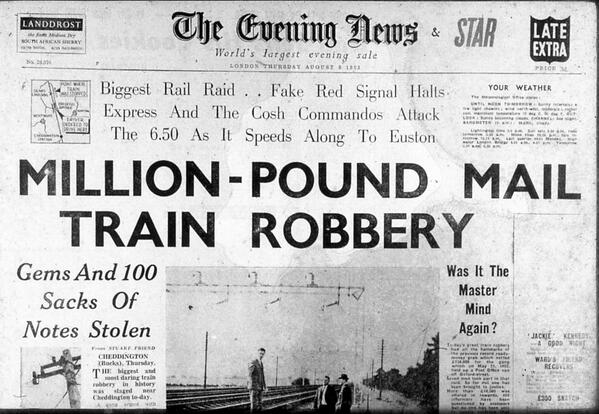
Sixty years ago, this month on 8th August 1963 the Glasgow–London Royal Mail Train was held up by 15 men, wearing helmets, ski masks, and gloves. The train was carrying mostly used bank notes to be destroyed. This was known as the Great Train Robbery.  The ringleader, Bruce Reynolds was a known burglar and armed robber. Just over £2,600,000 (£50m today) was stolen in an audacious and apparently well-planned heist aided by inside information. It only took 15 minutes. No firearms were used, although the train’s driver was seriously injured when bashed with a metal bar.

Before the Great Train Robbery, Reynolds had organised a gang and conducted a successful £62,000 airport robbery. Flush with this success, Reynolds began searching for ‘the next big one’. Upon identifying the opportunity, Reynolds realised that he needed help from the London underworld as his original gang could not do the job alone.

The train was stopped when the robbers turned off a green track signal with batteries and turned on a red signal. Approximately 120 mail bags were taken from the train to a farm hideaway, where it was divided up. During the robbery, one of the gang told the postal staff on the train not to move for 30 minutes. This information suggested to the police that the hideout was within a 30-mile radius.

On hearing on the radio that the police were narrowing the search, the robbers hurriedly left the farm the day after the robbery. Only five days after the robbery a local farm worker had noted suspicious vehicles at a neighbouring farm and advised the police. When two police came to the farm, they found the Landrovers and truck used in the robbery, plus bedding, food, post office bags, banknote wrappers and a monopoly board. Part of the plan was to burn down the farmhouse. However, the robbers in their haste left fingerprints on a tomato sauce bottle and the monopoly board. Apparently, the robbers had played monopoly with real money from the heist!

The robbery had attracted far more police attention than anticipated by the robbers. It also captured the imagination of the public and the media. A reward of £250,000 was offered. A breakthrough came when an informant gave the police a list of names. Some of the names were matched to the fingerprints from the farm. With this and other evidence, by Christmas 12 robbers had been caught, convicted and sentenced up to 30 years jail.

Only three of the robbers remained at large. Reynolds and two others went abroad to Mexico and lived the highlife. By 1968 Reynolds had spent most of his ill-gotten gains. He planned another large robbery and returned to England where he was arrested. Ronnie Biggs escaped from prison in 1965, fled first to Paris, then after undergoing plastic surgery travelled to Australia, and finally to Brazil in 1970. He remained at large as there was no extradition treaty between Brazil and the UK. In 2001 after suffering several strokes, he returned voluntarily to the England and was rearrested.

Are there any lessons here for managers in this ‘crime of the century’ (apart from the obvious lessons of crime not paying and it’s not a good idea to play Monopoly with real money)?

The robbery was well planned and executed with military precision. But by Christmas in 1963, 12 of the robbers had been arrested. Hardly a sign of success!

Here are three lessons I think we can take away from the Great Train Robbery:

  • 1. Have a vision.  

Reynolds as the leader was the brains behind the daring heist. Following the ‘success’ of the airport robbery, Reynolds wanted a bigger challenge. In the dialogue from a movie of the robbery, Reynolds was quoted as saying:

“You’ve got to dream big.  What are we here for if we don’t make our mark? It was never just about the cash.  It’s the buzz.  Building the team, finding the job, planning the job, carrying it out. It’s the camaraderie. Trusting other men with everything you know. With your life.”

Although this is a fictional quote it is probably is an accurate depiction of what occurred. Reynolds had clear vision – in other words a vision statement! The power of vision is very powerful. An ingredient of a successful business is to have a very clear vision.

  • 2. Plan thoroughly.

With a clear vision, Reynolds meticulously prepared and planned the robbery. He realised that the scope was beyond his immediate circle’s skills and quickly expanded the size and skills of the gang.  He was faced with needing specific skills to ensure success. This included how to fake the train signals to stop the train and how to drive the train once it was held up. Sound planning allowed the initial success of the robbery – in 15 minutes.

  • 3. You cannot plan for all eventualities and you should have a plan B.

Despite the meticulous planning, the robbers did not plan for all eventualities. In reality, in business it is also not possible to plan for all eventualities. However, you should always have a Plan B. A contingency plan if ‘things go wrong’. When calm leadership was required, the gang panicked when they heard that the police were searching within a 30-mile radius of the robbery. They left the farm and didn’t adequately cover their tracks. In other words, despite the planning there was poor execution which resulted in the robbers being caught.

In concluding, there is nothing like a good story to demonstrate a point and the Great Train Robbery certainly does this!

What do you think?

Note: I am not condoning the robbery that left the train driver seriously injured. Just using a well-known story as an example for managers. The robbery was a success, but many things went wrong after that.  The amount stolen was so much more than expected that it sparked a major investigation plus “crime of the century” publicity. The police response was swift and successful. An example of sound management and leadership.

#thenetworkofconsultingprofessionals

Rewriting history…

“Who controls the past controls the future. Who controls the present controls the past”

George Orwell – British author

My great great grandfather William and his wife Jane emigrated to Australia from the Orkney Islands, north of Scotland in the late 1850s. Initially he worked as indentured shepherd on a squatters run (sheep station) before conditionally purchasing land on which to farm. According to family ‘history’ he carried a newspaper clipping of the sinking of the ‘Dunbar’ in his wallet.

The ‘Dunbar’ was a sailing ship that operated on the Britain to Australia route in the 1850s. It was the pride of the Dunbar company fleet. It was modern (for those days) and fast. On the evening of 20th August 1857, the ‘Dunbar’ was wrecked whilst attempting to enter Sydney Harbour during a storm. There was only one survivor and 121 perished, many of whom were prominent and wealthy Sydney residents returning from England. The impact on the small Sydney community was immense. Many of the citizens viewed the wreck from the cliffs near the entrance to Sydney Harbour, witnessing bodies washing up and sharks feeding on the carcasses along with the wreck debris. An inquest was held within a week of the sinking. After only one day it found that the cause of the tragedy was an ‘error of judgement’ and ‘did not attach any blame to Captain Green or his officers’. However, this did not stop the politicians and the local media of the day in particular, from blaming the dead captain for the tragedy. It was far better to blame the dead captain than the contributing factors of the inadequate pilot service, lack of lights at the entrance to the harbour or the poor location of the Macquarie lighthouse.

So why did William carry this clipping in his wallet?

Because he and his wife were booked to sail on ‘The Dunbar’ and escaped certain death?

An interesting family story, but was it true?

The ship William and Jane sailed on, the ‘John Bunyan’ left Liverpool on 9th August 1857 and arrived in Sydney on 27th October 1857. The ‘Dunbar’ left Plymouth on 31st May 1857 and was wrecked on 20th August 1857. There are two inconsistencies here. The ‘Dunbar’ left Plymouth over two months before the ‘John Bunyan’ sailed from Liverpool. It is extremely unlikely that William and Jane would have been in England two months before they sailed. They were poor immigrants from the wet and windy Orkneys. They could not have survived this period of time waiting in England. The second inconsistency was that they left from Liverpool, a far closer port to Scotland than Plymouth which is located in the south of England.

So, the story was simply ‘family folklore’.

What are the lessons here for managers?

Don’t believe everything that you are told?

Check your facts and get to the source and question everything?

How often in organisations, is a person used as a scapegoat to ‘rewrite’ the organisation’s ‘history’ and justify new management?

In the book 1984 by Eric Blair (better known as George Orwell), the ‘hero’ of the novel, Winston Smith was introduced to the concept of ‘re-writing’ history when working at the Ministry of Truth. The Party understood that by rewriting the events of the past and controlling the narrative of history, they could maintain their position of authority. Captain Green of the ‘Dunbar’ was made a scapegoat for the tragedy. This often happens in organisations and in politics.

Note: There may be another explanation for the newspaper clipping story. The Captain and Second Officer were both from Orkney. They could have been known to my ancestors, although that is unlikely as they were from different islands – or perhaps they ‘felt lucky’ that they did not suffer the same fate as the passengers and crew on the ‘Dunbar’. By the time my ancestors arrived in late October 1857, Sydney was enmeshed in the ‘Dunbar’ tragedy – there had been wide media coverage, several books had been written, paintings completed, and artifacts from the wreck sold. They certainly would have known about the tragedy.

Who knows?

#thenetworkofconsultingprofessionals

It’s that time of the year again..

“Christmas is a season not only of rejoicing but of reflection”
Winston Churchill

In December 1843, Charles Dickens published his book A Christmas Carol. The book was set against significant changes in British society. As Britain industrialised there was a mass movement of people from the countryside to the cities. Dickens witnessed this change and the resulting appalling conditions of child labour.

The book’s messages are timeless. Radical for the time, one significant theme from the book is that employers were responsible for the wellbeing of their workers,

Firstly, lets briefly recount the story.

The book is about a mean-spirited and selfish old man called Ebenezer Scrooge who hates Christmas.

“Bah Humbug” he says.

Scrooge is unkind to the people who work for him. He does not accept an invitation from his nephew to spend Christmas with his nephew’s family. He also refuses to give to any charity. On Christmas Eve he is visited by the ghost of his former business partner Jacob Marley, who warns him that three ghosts will visit him that night.

The first ghost is the Ghost of Christmas Past. He takes Scrooge to his past as an unhappy child and to a man who forsakes his fiancée for the love of money. The second ghost is the Ghost of Christmas Present who takes him to the family of his clerk, Bob Cratchit. At the house Scrooge sees Cratchit’s ill son Tiny Tim. Then the ghost takes Scrooge to see his nephew’s Christmas celebrations he had refused to attend. The final ghost, the Ghost of Christmas Yet to Come shows Scrooge his own death and how he will be remembered. This terrifies him as there is no-one to mourn him.

The ghosts’ journey through time makes Scrooge see the error of his ways. On Christmas morning, Scrooge wakes up and is transformed into a kinder, gentler man. He buys the biggest turkey for the Cratchit family and then spends Christmas Day the day with his nephew and family.

What are the messages for employers and managers in A Christmas Carol?

With Christmas being at the end of the calendar year, it is an excellent time for managers to reflect, consider the past, in particular the past year, the present, and the future, just like the three ghosts.

As a manager and business owner what are you going to do about Christmas for your staff and customers?

It’s the season of goodwill – don’t waste the opportunity!

#thenetworkofconsultingprofessionals
Rabbits, dams and engineering faults!

“He who chases two rabbits, catches none”
— Confucius

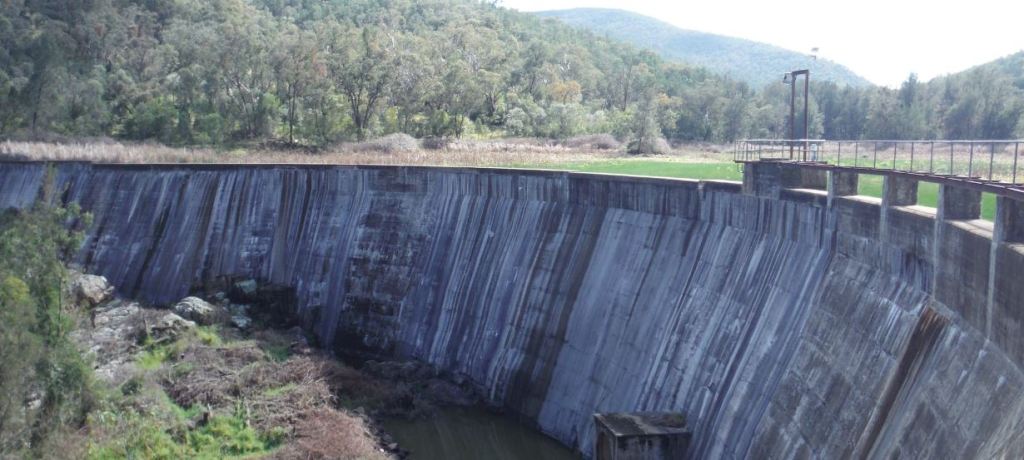
I grew up on a farm in northern NSW. Running through the property was a creek which had two significant dams on it. The first dam was called ‘the old Quipolly Dam’. This concrete span dam wall was built in the early 1930s to provide water for the town of Werris Creek, a town that did not exist until the coming of the railway in the mid-1870s. Being a major rail junction town, water was essential as steam engine locomotives require lots of water. The second newer dam bordered our property. It had an earth wall and was built in the late 1950s to replace ‘the old Quipolly Dam’.

By 1947, when my father moved onto our farm with his parents ‘the old Quipolly Dam’ had silted up. This was less than 15 years after it had been constructed. My father told me that during the 1940s drought rabbits had denuded the landscape. Without grass ground cover, heavy rain caused severe erosion. The sediment ended up in ‘the old Quipolly dam’ as silt. This seemed a logical explanation for the silting.

My father spent his whole life trying to eradicate rabbits on the farm. Trapping, poisoning, releasing calicivirus and myxomatosis viruses, ripping rabbit warrens and shooting them. As young boy I trapped and shot rabbits and every year we undertook a poisoning campaign.

So, the rabbits seemed to be a logical explanation.

Several years later I was doing some family history research and found an engineering research paper. It studied several small railway dams built between 1890 and 1932 in NSW that had silted up. One of dams studied was ‘the old Quipolly dam’. The research paper concluded that ‘the most extreme hydrological events are extreme floods following a long drought period’ and this led to where ‘large sediment loads are carried away into the reservoirs.’

So, were ‘the rabbits’ were responsible for the dams’ siltation problems?

Well, not exactly.

Whilst erosion was a contributing factor, the main reason was a design flaw in the dam’s walls. The basic design of the dam’s arch wall had not changed in over 40 years. This was despite the fact that several dams with curved concrete walls had silted up within 25 years, all before the construction of ‘the old Quipolly Dam’. The wall design did not consider the fundamental concepts of sediment transport. The dams did not have a large outlet for sediment ‘flushing’, resulting in a silt or sediment building up against the curved dam wall.

Rabbits and probably overgrazing that had denuded the landscape during a drought were not the underlying cause of the silting up of the dam, but a contributing factor only.

What do you think the management lesson is here?

Here are some to consider.

We can all remember being told something in our working lives and then finding out this was incorrect. Remember the ‘weapons of mass destruction’ that Iraq had that were used as a pretext for invasion?

Perhaps another lesson is not to believe what bureaucracies or governments do or tell you. In this example, there were several dams of similar design that silted up well before ‘the old Quipolly Dam’ was built.

  • Often, an explanation that seems logical may not be the cause of the problem. In this example, it was only a contributing factor.

As a logistics professional I am continually frustrated when allegedly logical transport solutions do not stand up to scrutiny. For example, a common theme pushed by politicians and special interest groups is that the construction of freeways increases pollution.

Really?

Think about it.

If we did not have freeways, cars, average speed would be lower, more stops and starts, traffic lights, slower travel times and more congestion and pollution.

Can you think of other examples in your working life where this has been the case?

#thenetworkofconsultingprofessionals
What is a KPI?

Key Performance indicator

What is a KPI?

‘The most important performance information that enables organisations or their stakeholders to understand whether the organisation is on track or not.’

Bernard Marr – author and futurist

What is a KPI?

A KPI (Key Performance Indicator) is used to measure the process towards an organisation’s goals.

Most managers and business owners know what KPIs are, based on the concept that ‘what gets measured gets done’. However, in many instances, organisations do not know what to measure and this results in poor management, mixed messages and focusing on the wrong things. One mistake is to confuse KPIs with goals. The goal of a business may be to increase sales to $20 million – however, it is not a KPI.

One of our first customers in our logistics business was a major Australian retailer who built a new store in a major shopping centre. Retailers normally have a KPI which measures sales per metre of their retail area. The ‘whiz kids’ at the retailer’s head office decided to minimise the ‘in-store’ storage areas to increase the total sales area. Within weeks of opening the new store, sales were suffering. The stock could not be replenished from the back of the store because not enough stock could be stored there. This resulted in reduced staff morale and new requirement to operate an off-site warehouse to replenish the store daily, which increased costs considerably. This is an example of a poor implementation of a KPI. The challenge is to select the right KPIs.

Why are KPIs important?

KPIs, if structured correctly and measuring activities towards a business’s goals, can have a positive impact on performance at all levels of a business. For example, KPIs can empower staff by showing how they can make a difference to the business, as well as holding them accountable.

In our logistics business, we designed a system that collected productivity data by customer, job and product category. The warehouses were divided into sections, each headed by a supervisor responsible for the customers and staff in their section. Each week, we produced productivity data by job and customer – which we called ‘the marking rate’. This information was shared with the supervisor, empowering them to make a difference to the business, holding them accountable, involving their team and demonstrating how important their team was in the business. They were empowered, which increased their levels of job satisfaction immeasurably. The marking rate was a measure which drove the business’s profits.

Not only do some organisations have the wrong KPIs, they often too many KPIs. In my experience, the number of KPIs should be restricted to between three and five, otherwise they can become too hard to measure and manage. I have seen large companies with literally dozens of KPIs, which rarely relate to the company’s goals. The challenge is to identify the key indicators that help the business succeed.

What are the three main considerations in setting KPIs?

  1. Ensure they are simple and are easily measurable and understood.

For example, in long-distance road transport, KPIs could be revenue per kilometre, kilometre per vehicle and fuel cost per kilometre. These performance indicators are easily understood and measurable.

  1. The measures must be key indicators of performance and directly linked to strategy.

Using road transport, the strategy is to maximise both kilometres travelled and revenue – so measuring revenue per kilometre is sensible.

  1. Minimise the number of KPIs, thereby making them relevant to all.

KPIs can be more precisely developed by using Key Performance Questions (KPQ), which assist in objectively developing activity measures that lead towards meeting the business’s goals. Here are some examples:

  • What are the activities we should measure that lead to high customer retention?
  • What should we measure that indicates profitability by customer?
  • Are the current productivity measures linked to the business’s goals?


Is a code of conduct important?

Code of Conduct

Is a code of conduct important?

‘Don’t violate your own code of values and ethics, but don’t waste energy trying to make other people violate theirs.’

Melody Beattie – American self-help author

What is a code of conduct and is it important for a business?

A code of conduct is a set of rules or standards that capture the beliefs and ethics on behavioural expectations in the organisation. There are many types of business codes ranging from financial reporting, conflicts of interest, health and safety, and communication to employment discrimination. A code of conduct sets out a common standard of performance for employees, while respecting the rights of employees and providing a framework for acceptable behaviour.

One of the best examples of a code of conduct is Rotary International’s Four-Way Test for use in professional and personal relationships:

  1. Is it the TRUTH?
  2. Is it FAIR to all concerned?
  3. Will it build GOODWILL and BETTER FRIENDSHIPS?
  4. Will it be BENEFICIAL to all concerned?

Codes of conduct are linked to corporate or organisational values and the mission statement. A good demonstration of the use of corporate values as a guide for decision-making is this example from one of the transport companies I worked for:

‘If you ask yourself the following five questions and you can answer ‘yes’ to all of them confidently, you should go ahead and make the decision:

  • Will the decision help me exceed customer expectations?
  • Is it respectful to all individuals – customers, suppliers, employees and community residents?
  • Does it further our goal of continuous improvement?
  • Is it in the long-term best financial interests of the company?
  • Can I do it safely and ethically?’

If the answer to any of these questions is ‘no’, then the decision you are about to make is unacceptable.

The values, in the form of a card that could fit into a wallet, were given to all staff so that the values could be referred to when required.

In our logistics business, we had a values statement which was as follows:

‘Customers and employees are our greatest assets. The company is committed to providing the highest level of service by working with its customers in an environment of continuous improvement through the introduction of new technology, superior systems, staff training and development.

Work performance and service quality is enhanced by giving responsibility to supervisors on the shop floor. The flat management structure drives the efficiency and effectiveness of the business. It has enabled the company to react quickly to opportunities and requests from current and potential customers.’

However, the statement did not set out specific values driving organisational behaviour – such as work standards, accountability, being open and fair, or personal interactions and behaviour. It did not summarise what needed to be done – for example, ‘we will celebrate success and encourage initiative’ – and what will not be done – for example, ‘we will not tolerate poor performance or rude and condescending behaviour towards others’.

Why was this important?

Because we did not have these values clearly defined, we could not use it as a basis for managing interpersonal conflict when the business was struggling in one area. The failure to accept responsibility for continuing unacceptable performance by a senior manager  who was in denial, and not having a clear values statement, resulted in an acrimonious and deteriorating situation.  Unfortunately, I did not manage the situation constructively at the time and, out of sheer frustration, I allowed my emotions to override a common sense approach to resolving the situation satisfactorily for the business.

Conflicts within organisations are inevitable. The challenge is to manage conflicts when they arise in a constructive way.

Does your business have a code of conduct?

Does it clearly set out the acceptable standards of behaviour as well as a framework to manage conflict?

For example, does it say ‘we will respect and support each other as individuals and members of the team’ and ‘we will recognise both group and individual results’ and ‘we will not ignore achievements or tolerate poor performance’?

#thenetworkofconsultingprofessionals

The power of a vision

The power of a vision

“I believe that this Nation should commit itself to achieving the goal, before this decade is out, of landing a man on the moon and returning him safely to earth”

John F Kennedy – USA President

This quote delivered in 1961 by President Kennedy is one of the best examples of a vision statement as within the decade, man had landed on the moon and returned safely. On 20th July 1969, astronauts Armstrong and Aldrin landed on the moon and returned safely to earth fulfilling Kennedy’s vision.  However, it is important to remember that the moon landing was the result of decades of work by hundreds of thousands of people working across the disciplines of science, technology, and engineering, peaking at a cost of 4.41% of the Federal US budget in 1966.

How important is it for an organisation to have a vision?

A vision is a picture or an idea. It helps focus us on the future, provides inspiration and assists in overcoming the obstacles that inevitably appear along the way. A vision is a target. It should be  aspirational, perhaps like the concept of a BHAG (Big Hairy Audacious Goal) as descibed in Jim Collins’ book; Built to Last: Successful Habits of Visionary Companies and be successfully communicated throughout the organisation.

An example of the power of an aspirational vision is Rotary International’s PolioPlus program. In 1979 Clem Renouf, the Australian President of Rotary International read in the Readers Digest how small pox had been eradicated. After discussing this with a medical expert, he had a vision that the world could be polio free. At the time, more than 350,000 people were infected by polio in 125 countries each year. Later that year Rotary’s Board of Directors passed a resolution for a program for “the eradication of poliomyelitis and the alleviation of its consequences” throughout the world. Subsequently, in 1985 the PolioPlus program was adopted with the aim of eradicating polio worldwide. With so many countries where polio was still endemic this was a challenging vision.

Rotary initiated the program and together with the support of UNICEF, WHO and other organisations such as the Bill and Melinda Gates Foundation have almost achieved Clem Renouf’s original vision. By 2017 only 22 cases of polio were reported in just three countries, Afghanistan, Nigeria and Pakistan. At times there were difficulties in overcoming cultural suspicion, low levels of education, training staff to manage and administer the program, political insurgencies and geographical remoteness. However, despite these obstacles, the original vision ensured the program continued. It is now almost complete.

There are many websites and other sources who provide a methodology on how to create a vision statement for your organisation. As can be demonstrated from the above two examples, strong and clear visions are powerful tools and have the ability to provide a framework for the future. Visions should be compiled into a vision statement in a suitable form to communicate to staff, customers, suppliers and other stakeholders. Vision statements define goals and assist in creating a path for the future.

Does your organisation have a vision statement?

If not, do you think that the organisation would benefit from having a vision statement?

President Kennedy and Rotary’s Clem Renouf’s vision are great examples of the impact of having a vision statement.

Are you a smart manager?

How-do-you-find-the-right-property-manager_578_6027403_0_14102514_1000

Are you a smart manager?

“If you are the smartest person in the room then you’re in the wrong room”

Anonymous

Michael Dell founder of Dell Computers has a similar quote “Try never to be the smartest person in the room. And if you are, I suggest you invite smarter people……..or find a different room”

As managers, what does this mean?

Logically the smartest person in the room should be the manager. After all, who will provide the direction and manage the organisation?

Quite clearly this is wrong.

Why?

The people who think they are the smartest person in the room tend to have the last say and rarely listen to or acknowledge different ideas or opinions. Many show their distain or disinterest by interrupting others in mid-sentence or displaying negative non-verbal traits such as rolling their eyes, looking away or checking their phone. I can remember organising a leadership training program for our Rotary Club for local businesses and organisations. A local council put up several candidates and one refused to attend stating “I have an MBA so I don’t need leadership training”

It would have been a waste of time and money for them to attend, not because of their MBA but because of their attitude.

However, learning should continue throughout your life, both at work and outside work. Learning does not stop with finishing school or a degree. People only learn and grow when being challenged. Being the smartest person in the room often means that you will not be challenged. Great managers surround themselves with people who challenge them as they realise that to continue to be relevant and innovative, you must be open to new ideas and concepts. By valuing other’s opinions and accepting that you are not always the smartest person in the room, healthy, constructive and sometimes heated debates will help your organisation and help you.

A business owner I know, who would be very smart and is well qualified academically, has failed to grow his business as profitably and quickly as planned. While he is a pleasant, polite and intelligent, he is rarely challenged and appears to not listen to others.  He claims he has little time or interest to read books. It would seem that these circumstances had adversely affected his staff turnover and business. Staff initiatives and ideas appear to be stifled. Being in charge does not mean you have all the answers. I have found that some of the smartest people can be found anywhere in an organisation, you just need to find and develop them. Many years ago, while working for a transport business I found a driver who had the attributes and energy to become a qualified driver trainer. Despite initially being hostile to management. he turned his experience into a new position, where he greatly added to the business by training drivers, thereby reducing accidents, injuries and fuel consumption. Furthermore and probably more importantly this improved his motivation and morale, and his own self image.

As managers we probably all have the tendency to act as the smartest person in the room.

The challenge is to resist this temptation without of course, abdicating your responsibility as a manager.

Here are 3 suggested to being a smart manager approaches:

  1. Ask more questions and listen for the answers. Questions are powerful leadership toolResist telling people what to do and respond to ideas with questions to help you and others better develop their ideas. Seek first to understand before offering your own perspective.
  2. Have the courage to remain silent and help others decide. This does not mean that you cannot veto an idea or approach. Through using open questioning techniques ideas can be modified or adapted in a constructive way to get the best outcome.
  3. View ideas as a ‘glass half full’ not ‘half empty’ as it is a positive approach. People respond to the positive rather than the negative. Negative discussions should only centre around risks.

As a manager can you resist the temptation and follow these approaches?

These approaches often challenge us as managers, although they highly likely to engage and motivate our subordinates, make them feel part of a team and allow new ideas and approaches to surface. You will be challenged.

Why don’t you ‘give it a go’?...

Using visual symbols to communicate…

82 Overcrowded Bus.

Using visual symbols to communicate…

“The best leaders… almost without exception and at every level, are master users of stories and symbols”

Tom Peters – Business Author

I have just arrived back today from travelling in Africa …..

We often hear business leaders and politicians trying to communicate messages unsuccessfully. Why?

Are they using too many words, the wrong words or just words? Communication is not just verbal. It is estimated that over 65% of all communication is non-verbal. Eye contact, facial expressions, appearance and gestures influence how you interpret the message.

This is where the use of symbols become important in communicating. This can be used in the workplace.

Recently I was confronted with trying to express the importance and urgency of cultural change to an organisation that was underperforming. Presenting to the Board I realised that the use of symbols or visual imagery would help communicate the issues and how to manage the change.

The visual imagery I decided to use was taken directly out of Jim Collins’ management book, “From Good to Great – why some companies make the leap and others don’t”.

I used the symbol of a bus. The symbolism was very easy to understand and is very clear.

From a PowerPoint slide showing a red bus presented to the Board, the concept developed to using a model of a toy bus. The bus had the company’s logos on the side, and on the roof was an arrow pointing forwards indicating progress and moving ahead with the Jim Collin’s quote:

“Get the right people on the bus, the wrong people off the bus, and the right people in the right seats”

The toy bus sat on the meeting room table for all to see. Later we added Lego people getting on and off the bus – normal people getting on, and pirates, wizards and clowns getting off the bus. The toy bus was regularly referred to when explaining a person’s performance or suitability and became a clear way of communicating.

Staff were often asked: “Are you on the bus?” and ‘Are they on the bus?”

It became a powerful visual symbol. When management spoke about what needed to happen it was described in terms of being on the bus. It was a clear message and was understood from the managing director to the staff on the shop floor.

We implemented daily ‘toolbox’ meetings with staff. We called the location ‘the bus stop’ further reinforcing the message.

Using symbols in business as a tool is a very important part of communicating, both with your current and prospective customers and staff. If the symbol is compelling enough it will become part of the organisation’s culture.

Can you think of a symbol used by an organisation that is easily recognisable and understood?

What about your organisation?

Business Storytelling

storytelling-18642-3-1940x1293 (1)

Business Storytelling

“Storytelling is about two things; it’s about character and plot”

George Lucas

I have just been trekking in the McDonnell Ranges near Alice Springs in Central Australia in the great Australian Outback! What an amazing scenery ranging from spinifex and mulga covered hills to gorges of ferns and white river gums…

Well might you ask what has a quote from a famous movie director got to do with business story telling?

Using stories in business as a communication tool is a very important part of communicating with your current and prospective customers. If the story is compelling enough or inspiring enough it will become part of the culture of the business demonstrating your values and where the company came from. More importantly it helps sell your products and services.

Everybody likes a good story and like what George Lucas says the plot and character are vital. I find stories about how businesses start as the most compelling and fascinating. Hewlett-Packard was started in a garage by Dave Packard and Bill Hewlett in 1938 and the garage is now part of company culture. What an inspiring story!

I once worked for a company where the owner in his mid-50s lost his business his father and uncle had established after fleeing the Nazis in Europe. He and his daughter commenced a new business in their rented flat on their kitchen table – it later became the largest supplier of sleeping bags in Australia. What a compelling story for staff and customers…..

People whether staff or customers warm to stories of success from hardship – a plot and character just as George Lucas suggests. It’s emotional and uplifting. However the story must be authentic – if you are not authentic it damages you and your business or brand.

I visited Nepal just over 2 years ago with an Associate to assist a locally owned and managed travel company to improve their business. It was a both an exciting and rewarding experience and hearing how the business commenced was inspiring and a great story.

As a young boy, the founder watched groups trekking through his village in northern Nepal. He had a vision and decided to create his own future. Whilst in his early teens he went to Kathmandu to high school without his family (in Nepal high schools are only in the largest cities). From there he worked in a hotel as a porter, before moving into hotel reception. To gain practical experience in trekking he became a guide, completed his university studies before establishing his own tour company. All this was less than 15 years ago. It is now one of the largest trekking companies in Nepal. As well as offering employment and training in a comparatively poor country, he also has a mission to give back something to the people of Nepal. He instigated school building projects in poor and remote areas as well as making significant financial donations are to schools in these areas.

Both are good examples of stories that can inspire staff because they explain where they came from and help embody the values and provide the foundation of the culture and vision for the company.

Do you have some great stories you can tell your customers and staff?

……………it will help give colour to your communication.